What Is a Context Engineering Platform?
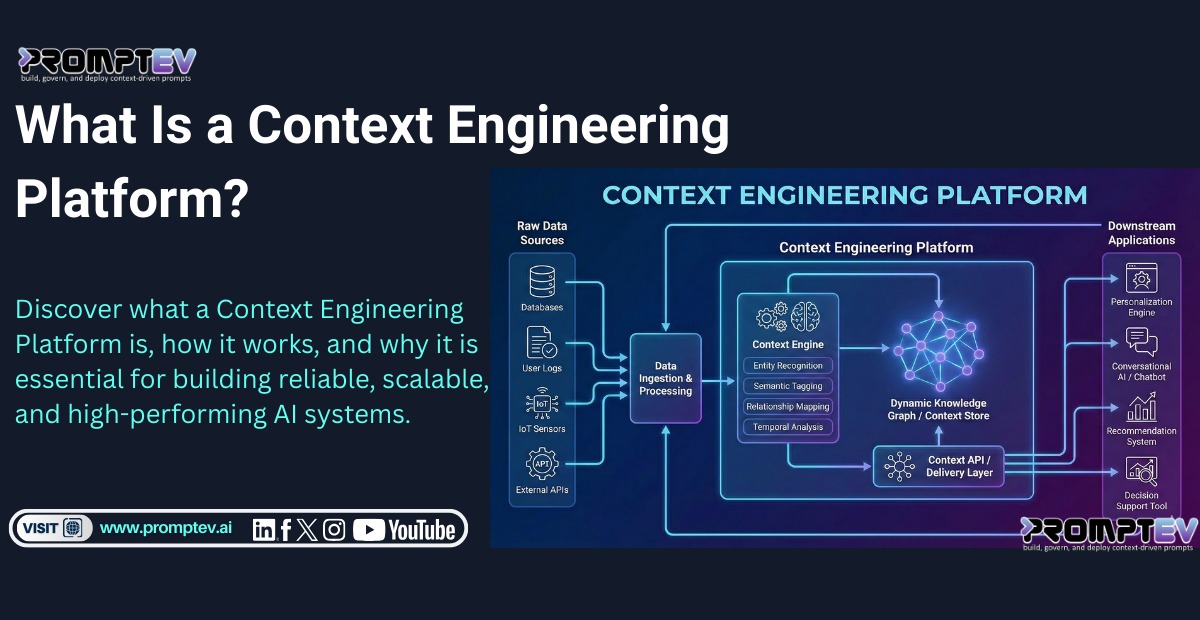
AI systems are becoming more advanced every day, but even the most powerful models struggle without the right context. You can write a perfect prompt or build a smart agent, yet the output still feels incomplete, inconsistent, or inaccurate.
Why does this happen?
Because AI doesn’t just need data, it needs a structured, organized, and meaningful context.
This is where the Context Engineering Platform comes in. It acts as the missing layer between your AI models and the information they use. It organizes knowledge, manages memory, and orchestrates workflows. It also ensures AI always knows what to use, when to use it, and how to use it.
In this article, you’ll learn what a context engineering platform is, how it works, why it matters, and how it transforms AI performance for businesses.
What Is a Context Engineering Platform?
A Context Engineering Platform is a specialized system that structures, manages, and delivers the right information to AI models at the right time. Instead of relying on raw prompts, it builds a strong contextual layer that helps AI generate accurate, relevant, and reliable outputs.
It works as an intelligence layer on top of your AI stack. It ensures every model interaction is rule-guided and domain-knowledge.
In simple words:
A context engineering platform makes sure your AI always knows “what’s going on” so it can respond correctly.
Why AI Needs a Context Engineering Platform
If truth be told, AI models are powerful, but they’re not perfect. Even the best models forget earlier instructions without a structured context.
5 Reasons: Why AI Fails Without Proper Context
Forget Important Instructions
LLMs have limited attention windows. As conversations become longer, earlier instructions gradually “fall out” of the model’s memory. This leads to situations where AI forgets the rules you set at the beginning and starts responding based only on the most recent messages. This creates confusion and frustration for users.
Inconsistent Responses
AI answers the same question differently without a stable contextual foundation. One moment it follows brand tone, the next it switches style. Sometimes it gives a correct answer, other times it drifts off-topic. Since LLMs rely on whatever context they receive at the moment. But small changes in inputs can cause big variations in output. This makes AI unreliable for serious business use.
Disconnected Data
LLMs are not automatically capable of connecting data from multiple sources. They can’t blend information from PDFs, emails, knowledge bases, databases, and APIs unless someone manually prepares and structures it. This results in fragmented responses where the AI sees each data point in isolation rather than as part of a larger ecosystem.
Broken Workflows
AI agents often fail in multi-step processes because they can’t track the full workflow logic. Without context, agents lose awareness of what step they are on, what they have already completed, and what the next step should be. This causes looping, repetitive tasks, skipped steps, and incomplete outcomes.
Complex Business Logic
Businesses operate on rules, policies, compliance requirements, and structured procedures. LLMs are not inherently good at remembering these rules consistently. They can misinterpret policies, ignore safeguards, or produce answers that violate internal guidelines. Domain-heavy tasks like finance, healthcare, legal, and HR are especially at risk.
How a Context Engineering Platform Works
A context engineering platform operates like the “brain management system” for your AI. Instead of depending on scattered prompts, it builds a structured environment where AI can truly understand, remember, and reason.
Let’s discuss how a context engineering platform works and understand things:
Context Versioning
Just like software has versions, AI’s knowledge and instructions also evolve. Context versioning ensures those changes are tracked, organized, and controlled.
With versioning, teams can:
- Monitor how instructions and rules change over time
- Update business logic without breaking existing workflows
- Revert to a previous context if something stops working
- Maintain consistent outputs across agents and projects
- Support multiple versions of the same agent for A/B testing
This creates a predictable and stable environment where AI responses remain reliable.
Centralized Knowledge Layer
This is a structured repository where all essential knowledge lives. But it’s not just a storage space; it’s an organized intelligence layer.
It includes elements like:
- Long-term memory of previous interactions
- High-level business rules and brand guidelines
- Project-specific context
- User personas and profiles
- Policies, compliance, and legal frameworks
- Product documentation and technical details
- Domain knowledge unique to your industry
Instead of dumping raw data into an LLM, the platform structures this knowledge so AI can understand it. effectively. This is what enables accurate reasoning and consistent decision-making.
Intelligent Retrieval & Orchestration
AI doesn’t need all the information at once; it only needs the right information at the right time.
This is where intelligent retrieval comes in.
The platform identifies and supplies the most relevant context based on:
- The conversation’s direction
- The task or workflow step
- The user’s intent
- The agent’s goal
- Historical context
- Real-time inputs
It uses smart techniques such as:
- Adaptive retrieval that adjusts to user intent
- Dynamic context loading based on model needs
- Memory indexing for fast access to relevant knowledge
- Conversation-aware selection that understands the dialogue flow
- Multi-document reasoning to combine insights from different sources
This ensures the AI always operates with precision, not guessing due to missing context.
Agent & Workflow Integration
A context engineering platform doesn’t work in isolation. Its real power comes from connecting seamlessly with the tools and agents your business uses.
It integrates naturally with:
- AI agents performing autonomous tasks
- Customer support chatbots
- RAG (Retrieval-Augmented Generation) systems
- Automation pipelines
- Internal knowledge bases and wikis
- External APIs and data sources
- CRM, ERP, HR, and other business applications
Companies can build AI workflows that don’t break under complexity with these integrations.
Who Needs a Context Engineering Platform?
Any business using AI beyond simple tasks can benefit from this platform.
- Enterprises: For customer support, operations, compliance, HR, and knowledge management.
- SaaS Companies: To embed reliable AI agents inside software.
- Agencies & AI Consultants: To design stronger workflows for clients.
- Developers: To scale agents without writing complex chaining logic.
- Startups: To build AI-native products faster and more reliably.
Wrap Up
A context engineering platform is the core infrastructure for modern AI systems. It gives LLMs the structure, memory, and intelligence they need to work reliably at scale. Instead of relying on prompts, businesses get a powerful execution layer that supports agents, workflows, and enterprise automation.
As AI continues to grow, the companies that embrace context engineering will build faster, innovate sooner, and outperform competitors who still rely on basic prompting.
FAQs
What is a context engineering platform?
It’s a system that structures, manages, and delivers the right information to AI models, enabling accuracy, consistency, and reliability.
How is it different from prompt engineering?
Prompt engineering tells AI how to answer. Context engineering tells AI what it needs to know.
Do AI agents need a context platform?
Yes. Without it, agents forget instructions, hallucinate, and break workflows.
Can it work with existing AI tools?
Most platforms integrate with RAG systems, agents, APIs, and business apps.
Who should use context engineering platforms?
Enterprises, SaaS companies, developers, agencies, and any business scaling AI.

Faisal Saeed is Founder & CEO of Promptev, building next-gen context engineering infrastructure that enables teams to orchestrate, scale, and deploy production-ready generative AI systems with confidence.