What Is Agentic AI and Why It’s Becoming a Must-Have in 2026
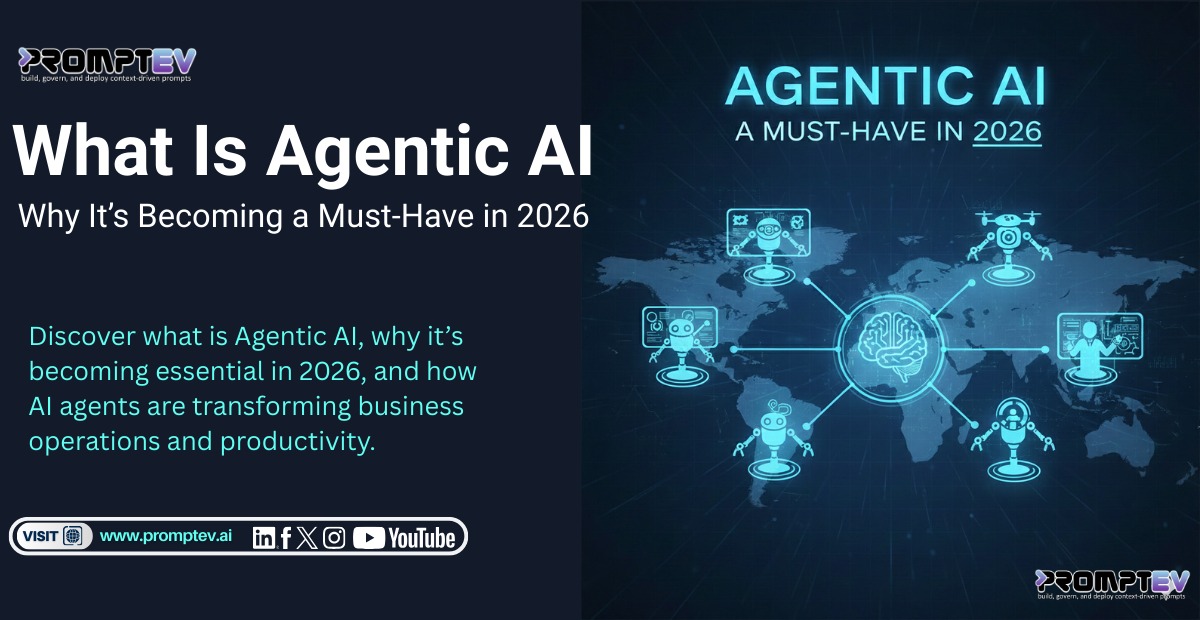
In 2026, businesses are increasingly embracing Agentic AI to streamline operations, boost productivity, and maintain a competitive advantage. Unlike traditional AI, which reacts to direct instructions, agentic AI functions autonomously, making decisions, initiating actions, and completing complex tasks without constant human supervision.
This growing trend is driven by the rising complexity of modern business workflows. Companies require AI that can operate independently, learn from outcomes, and dynamically adjust strategies. This level of autonomy unlocks greater efficiency, faster decision-making, and accelerated innovation.
In this article, we will discuss what is agentic AI and why it is becoming a must-have in 2026.
Let’s start with a better understanding!
What Is Agentic AI?
Agentic AI refers to AI systems capable of understanding objectives, making independent decisions based on context and data, taking autonomous actions to complete tasks, and learning from results. These systems leverage advanced machine learning, context-aware workflows, and sometimes multi-agent orchestration to operate with minimal human input. This transforms AI from a passive tool into a proactive collaborator capable of strategic action.
Unlike conventional AI, which requires explicit instructions for every step, agentic AI can plan multi-step actions, coordinate across systems, and prioritize tasks in alignment with business objectives.
Key Features of Agentic AI
Agentic AI is defined by several distinguishing features, which make it capable of handling complex environments:
- Autonomy: Executes tasks without continuous human guidance.
- Learning and Adaptation: Continuously improves performance through experience.
- Multi-Agent Coordination: Collaborates with other AI agents to handle complex objectives.
- Context Awareness: Understands business goals and adjusts actions accordingly.
- Proactive Decision-Making: Anticipates needs and acts before being prompted.
These capabilities enable agentic AI to navigate complex, dynamic business environments effectively.
Why Agentic AI Is Essential in 2026
The business environment in 2026 demands agility, scalability, and efficiency. Agentic AI addresses these needs in multiple ways. It manages workflows involving multiple systems, data streams, and decision points.
Automating repetitive and decision-intensive tasks allows employees to focus on strategy and creative problem-solving. It accelerates decision-making by evaluating data faster than human teams alone, while scaling operations without proportionally increasing headcount.
Plus, agentic AI explores solutions independently, uncovering opportunities and optimizing processes that were previously time-consuming. By integrating agentic AI, businesses gain a competitive edge in a rapidly evolving market.
How Agentic AI Actually Works
Agentic AI works by managing and shaping context, not just by generating answers. You start by giving it a clear goal. The system then builds the right context around that goal, including rules, data, tools, and limits. This context guides every decision the AI makes.
AI understands your intent and defines what success looks like. Then it breaks that goal into smaller steps and creates a focused context for each step. It removes irrelevant information and keeps only what matters for the task at hand. This helps the AI stay accurate and efficient.
Agentic AI Applications Across Industries
Agentic AI is highly versatile and capable of transforming operations across multiple sectors. Its applications include:
1. Finance
Autonomous trading agents that can execute trades in real-time, predictive risk assessment tools, and AI-driven fraud detection systems that flag unusual transactions with minimal human intervention.
2. Healthcare
AI agents coordinate patient care by scheduling appointments, managing follow-ups, assisting in diagnostics with data-driven insights, and streamlining administrative tasks to allow healthcare professionals to focus on critical patient care.
3. E-commerce
Personalized shopping assistants that tailor product recommendations for each user, dynamic pricing agents that adjust costs based on demand and inventory, and intelligent inventory management systems that reduce waste and ensure stock availability.
4. Marketing
AI-driven campaign planning and optimization, lead scoring systems that prioritize high-value prospects, automated customer engagement through chatbots and email workflows, and sentiment analysis tools to better understand market feedback.
5. Logistics
Route planning algorithms that optimize delivery schedules, warehouse management agents that track inventory efficiently, and supply chain optimization tools that anticipate demand and prevent bottlenecks.
6. Legal
AI agents assist in contract review, legal research, compliance monitoring, and case prediction, enabling faster and more accurate legal decision-making.
Across all these industries, agentic AI not only automates complex processes but also enhances decision-making by analyzing large volumes of data quickly and accurately. By deploying agentic AI, organizations can improve operational efficiency, reduce costs, increase responsiveness, and gain a competitive advantage in their respective markets.
5 Steps to Implement Agentic AI
To adopt agentic AI effectively, businesses should follow strategic steps:
- Identify tasks suitable for autonomy to determine which processes will benefit most from independent AI action.
- Invest in context-aware systems that allow AI to understand objectives, context, and priorities.
- Establish monitoring and feedback loops with dashboards, alerts, and oversight mechanisms.
- Train staff to collaborate with autonomous AI agents efficiently.
- Pilot deployments in controlled environments before scaling across operations.
These steps ensure smooth implementation and maximize the benefits of agentic AI.
Final Thought
Agentic AI represents the next evolution of artificial intelligence—a proactive, autonomous partner in business operations. By 2026, it will be a must-have for organizations seeking efficiency, scalability, and continuous innovation.
Businesses that understand and leverage agentic AI today will not only streamline complex workflows but also gain a decisive competitive advantage. Platforms like Promptev enable this shift by transforming agentic AI from a standalone tool into a structured, context-aware system that works across real business knowledge. The result is AI that operates as a true strategic asset—driving smarter decisions, faster execution, and long-term business impact.
FAQs
1. What is Agentic AI?
Agentic AI is a type of artificial intelligence that operates autonomously, makes decisions, initiates actions, and adapts to outcomes without requiring constant human guidance.
2. How can Agentic AI benefit businesses?
Agentic AI increases efficiency, reduces operational costs, improves decision-making, and enables scalability by handling complex tasks autonomously.
3. Which industries can leverage Agentic AI?
Agentic AI can be applied across finance, healthcare, e-commerce, marketing, logistics, and legal industries to automate tasks, optimize operations, and enhance performance.
4. What are the key features of Agentic AI?
Key features include autonomy, learning and adaptation, multi-agent coordination, context awareness, and proactive decision-making.
5. How should organizations implement Agentic AI?
Organizations should identify tasks suitable for autonomy, invest in context-aware systems, set up monitoring protocols, train teams, and pilot deployments before full-scale implementation.

Faisal Saeed is Founder & CEO of Promptev, building next-gen context engineering infrastructure that enables teams to orchestrate, scale, and deploy production-ready generative AI systems with confidence.