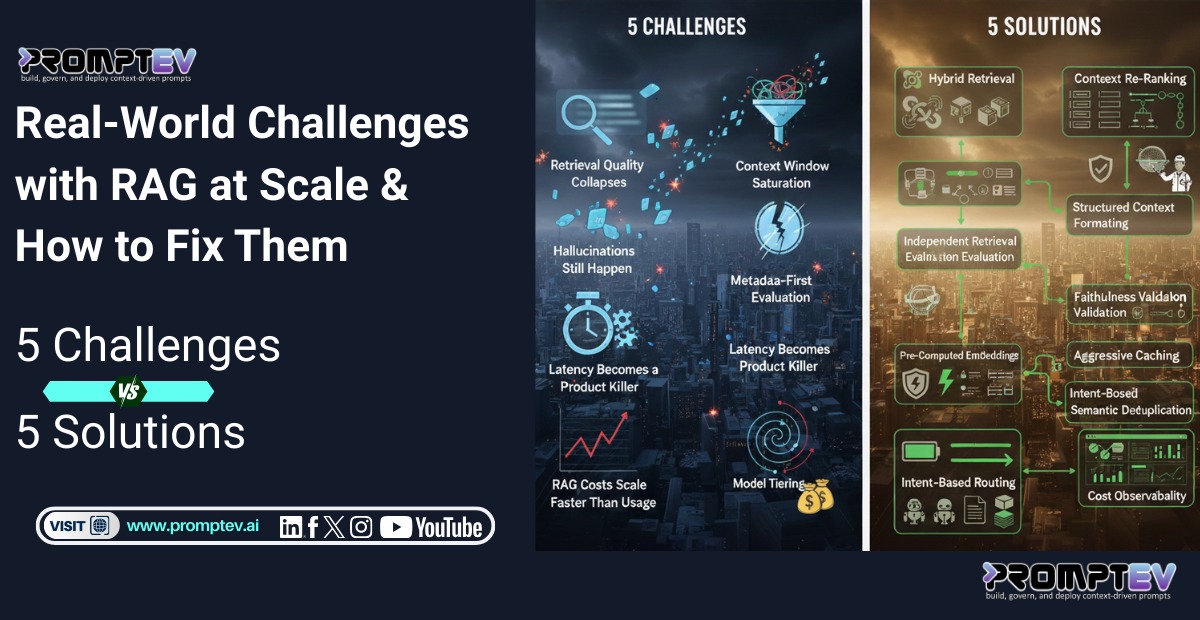
Real-World Challenges with RAG at Scale & How to Fix Them: 5 Challenges vs 5 Solutions
Retrieval-Augmented Generation looks deceptively simple. You connect your documents, embed them, store them in a vector database, and pass the retrieved context to an LLM. In early demos, the answers feel magical.
But real businesses don’t run demos. They run thousands of queries per day, across millions of documents, with real consequences if the answer is wrong.
As soon as RAG systems move from proof-of-concept to production, cracks appear. Accuracy degrades, latency grows, and Hallucinations return.
This article explains why RAG fails at scale in the real world and how you can fix it with practical strategies.
What “RAG at Scale” Actually Means
Most teams think scale means “more documents.” That’s only part of the problem.
RAG at scale means your system must operate reliably under data complexity, user diversity, and business constraints. The difficulty isn’t volume alone; it’s the interaction between components.
In real organizations, RAG must handle:
- Millions of document chunks across formats
- Rapidly changing knowledge
- Multiple teams, roles, and permission levels
- High query concurrency
- Zero tolerance for confident but wrong answers
At this point, naive RAG architectures collapse because they were never designed for semantic entropy at scale.
Challenge 1: Retrieval Quality Collapses as Data Grows
When your dataset is small, vector search feels magical. The embeddings are clean, distances are meaningful, and the top-k results usually contain what you need.
As the dataset grows, the embedding space becomes crowded. Semantic similarity starts to blur. Documents that are vaguely related begin to look “close enough,” while truly relevant chunks fail to appear in the top results.
This is the single most common failure mode of large RAG systems, and it happens silently.
Why does this happen?
- High-dimensional embedding spaces lose discrimination
- Generic language dominates similarity
- Important domain-specific signals are drowned out
Solution: How to Fix Retrieval Quality Collapse
You should not fix generation first. You should fix the retrieval. If the system pulls the wrong data, the model will fail. No prompt can fix bad retrieval.
Hybrid Retrieval
Hybrid retrieval uses both vector search and keyword search. Vector search understands meaning, while keyword search catches exact words. When you combine both, retrieval becomes more accurate and reliable.
Smarter Chunking
Chunking should follow meaning, not token size. Keep headings with their content and avoid breaking sections. Clear chunks help the system understand context and reduce mistakes.
Metadata-First Filtering
Metadata filtering narrows the search space before similarity scoring. When you filter by document type, date, or product, retrieval becomes faster and more precise.
Independent Retrieval Evaluation
Retrieval should be tested on its own. If the correct documents do not appear in the results, the model will guess. Fix retrieval first, or hallucination is guaranteed.
Challenge 2: Context Window Saturation
When answers start going wrong, teams often react by increasing top_k. More context feels safer. In reality, it creates a new failure mode.
LLMs don’t read context like humans. They prioritize, compress, and sometimes ignore information entirely. When the prompt becomes bloated, important facts lose prominence, and irrelevant text distracts the model.
Solution: How to Fix Context Window Saturation
You should not just add more context. You should engineer it. More data does not mean better answers. The model works best when it receives only the most useful information.
Source Attribution
Context Re-Ranking
After retrieval, you should rank the results again. Cross-encoders help you measure true relevance. When you send only the best chunks to the model, accuracy improves and noise drops.
Query-Aware Compression
Long documents should not go in as they are. You should compress them based on the user’s intent. Only the parts that answer the question should be passed to the model.
Structured Context Formatting
Structure matters more than people think. When you use clear headings like definitions or examples, the model understands faster. LLMs follow structured content better than raw text.
Dynamic Token Budgeting
Not every query needs the same context size. Simple questions need less data. Analytical questions need more evidence. Adjusting context size improves clarity and focus.
Challenge 3: Hallucinations Still Happen
Many teams believe hallucinations mean “the model made something up. At scale, hallucinations are subtler.
The model may:
- Combine two similar but incompatible facts
- Answer confidently using outdated context
- Infer missing details instead of admitting uncertainty
- These hallucinations feel reasonable, which makes them dangerous.
Solution: How to Fix Hallucinations
Hallucination control is not a prompt trick. It is a system design problem. If the system allows guessing, the model will guess.
Strict Grounding Rules
The model should answer only from the provided context. It should also be allowed to say “not found” when the data is missing. This simple rule removes most false answers.
Faithfulness Validation
Every claim in the answer should link back to the retrieved content. If a statement has no support, it should be rejected or penalized. This keeps responses tied to real data.
Source Attribution
Each part of the answer should include a source. When the model knows it must cite evidence, unsupported reasoning drops sharply.
Confidence-Based Fallbacks
When retrieval confidence is low, the system should not force an answer. It should ask for clarification or send the case to human review. This prevents silent failure.
Challenge 4: Latency Becomes a Product Killer
In small systems, latency is barely noticeable. Each step, such as retrieving documents, filtering results, re-ranking relevance, constructing prompts, and generating answers, happens almost instantly.
However, at scale, these steps compound. Large datasets, multiple queries, and complex context dramatically increase processing time. Retrieval and filtering take longer, re-ranking adds computation, and bigger prompts slow down inference.
- Even slight delays across steps accumulate.
- Users notice only the slowness, not the technical reasons.
If responses feel slow, engagement drops, accuracy alone is not enough.
Solution: How to Fix Latency Issues
Low latency is not something you fix later. It is an architectural choice. If speed is slow by design, no small optimization will save it.
Pre-Computed Embeddings
You should never create embeddings at query time. All embeddings must be pre-computed and stored. Batch processing is required to keep the system fast and stable.
Parallel Pipelines
Retrieval, filtering, and ranking should run in parallel. When steps run one after another, latency increases. Asynchronous pipelines reduce wait time and improve response speed.
Aggressive Caching
Frequent queries and popular documents should be cached. You should also cache re-ranked results, not just raw retrieval. This avoids repeating expensive work.
Model Tiering
Small models should handle retrieval and routing. Large models should be used only for final reasoning. This balance keeps the system fast without losing quality.
Challenge 5: RAG Costs Scale Faster Than Usage
RAG systems often seem affordable during early experiments. When you’re testing with a small dataset or a few queries, costs feel negligible. However, as the system scales to more documents, more costs grow.
- Every query may require multiple steps that each add to the expense:
- Multiple retrieval passes to find the right context
- Re-ranking model calls to prioritize the most relevant chunks
- Large context windows, which increase token usage
- Premium LLM inference, which is costly per call
These costs accumulate quickly, and without careful monitoring or optimization, the system becomes financially unsustainable, even if it works perfectly.
Solution: How to Fix RAG Increasing Cost
Cost control starts with discipline, not discounts. If you waste tokens, lower prices will not help.
Context Minimization
Smaller prompts reduce token usage. You should send only what is needed. Precision matters more than completeness when controlling cost.
Intent-Based Routing
Not every query needs a large model. Simple questions should go to smaller models. Smart routing cuts cost without hurting quality.
Semantic Deduplication
Similar questions appear again and again. When you detect them, you can reuse previous answers. This saves tokens and time.
Cost Observability
You must track cost per query, per team, and per feature. When cost is visible, product owners make better decisions.
Final Word
Retrieval-Augmented Generation does not fail at scale because the concept is weak, but because it is often treated as a simple feature instead of a critical infrastructure. As data grows and usage increases, weaknesses in retrieval and governance compound quickly. Reliable RAG systems require deliberate context engineering, strong retrieval discipline, continuous evaluation, and clear cost and latency controls. In this article, we have discussed the 5 real challenges with their solutions. So, if you’re facing one of them, this article will help you a lot.
FAQs
1. Why does RAG performance degrade at scale?
Because embedding similarity loses precision as datasets grow and context becomes noisy.
2. Can RAG fully eliminate hallucinations?
No. Governance, evaluation, and fallback logic are still required.
3. Is hybrid search necessary for enterprise RAG?
Yes. Vector search alone is insufficient at scale.
4. What is the highest hidden cost in RAG systems?
Large context windows and unnecessary LLM calls.
5. How is context engineering different from RAG?
RAG retrieves data. Context engineering structures, filters, and governs it.

Faisal Saeed is Founder & CEO of Promptev, building next-gen context engineering infrastructure that enables teams to orchestrate, scale, and deploy production-ready generative AI systems with confidence.