Your RAG Pipeline Isn’t Performing: 5 Real Reasons and How to Fix It
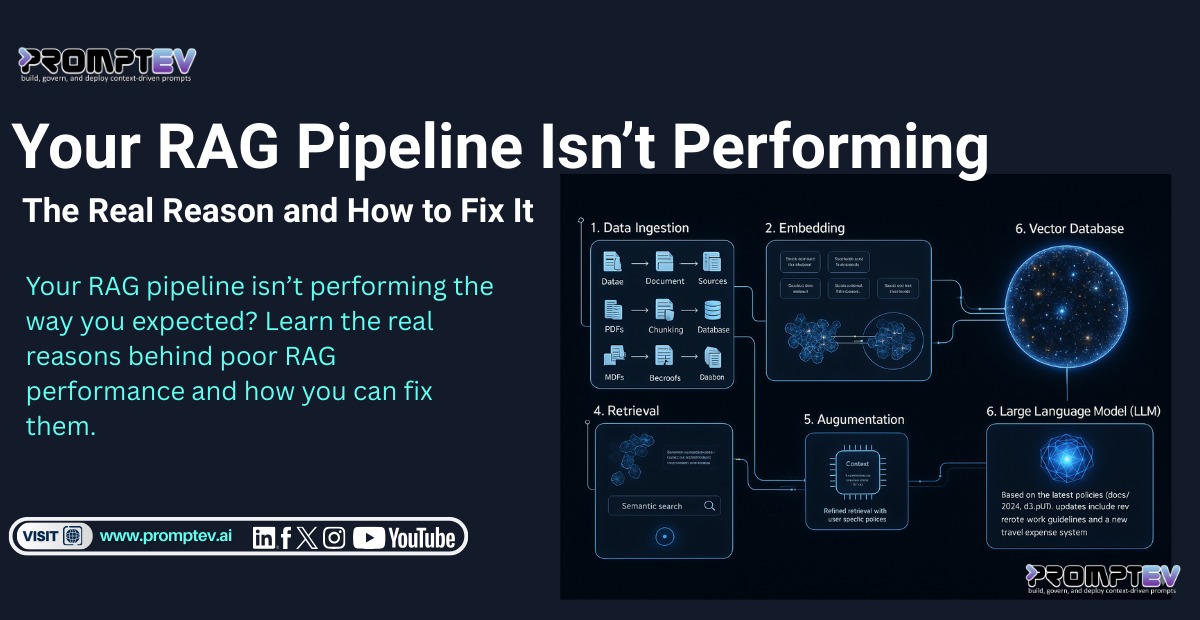
You built a RAG pipeline because it promised accurate answers, grounded outputs, and production‑ready AI behavior. On paper, everything looks right. You have embeddings, a vector database, retrieval logic, and a powerful LLM sitting at the end.
But in reality, your results feel disappointing.
Responses are vague. Hallucinations still appear. The system misses obvious information. Sometimes it answers confidently, and still gets things wrong. You tune prompts, swap models, and add more data. Yet performance barely improves.
Most teams focus on tools. Very few focus on how context is engineered, structured, versioned, and delivered to the model. And that gap is the real reason RAG systems underperform in production.
Let’s break down exactly what’s going wrong and how you can fix it properly.
Why Most RAG Pipelines Look Good but Perform Poorly
You probably followed a standard setup. You chunk documents and generate embeddings. You store them in a vector database. You retrieve top‑k results and pass them into the prompt. You expect magic. This approach works for demos. But it fails at scale.
The problem is not that retrieval augmented generation is flawed. The problem is that most RAG pipelines treat context as raw data instead of a managed system. When you do that, several issues appear immediately.
Your retrieved chunks don’t align with the user’s real intent. Your context window gets polluted with irrelevant information. Your instructions compete with the retrieved text, and your model has no idea what actually matters.
From the model’s perspective, everything looks equally important. That’s not intelligence; instead, it is noise.
The Real Reason Your RAG Pipeline Isn’t Performing
The real issue is simple but uncomfortable. You are feeding information into the model, not context.
Context is not just text; it includes the following:
- Intent
- Priority
- Rules
- Constraints
- Freshness
- Source reliability
- Task boundaries
Most RAG pipelines ignore these dimensions entirely. You retrieve content based on similarity alone and hope the model figures everything out. Sometimes it does, and often it doesn’t. When performance drops, teams usually react in the wrong way.
They add more documents and increase chunk overlap. They raise top‑k and change the LLM. All of this increases cost and latency without fixing accuracy. That’s why your RAG pipeline performance plateaus quickly.
RAG Pipeline Issue 1: Retrieval Without Intent Awareness
Your retriever doesn’t understand why the user is asking the question. It only understands vector similarity. That means it retrieves text that looks similar, not text that is actually useful.
If a user asks a strategic question, your system might retrieve procedural documentation. If they ask about policy, it might return marketing content. From the model’s perspective, this creates confusion. You can’t expect reliable answers when retrieval ignores intent.
How to Fix It
- You need an intent layer before retrieval.
- When you classify user intent first, you can:
- Route queries to the correct data source
- Apply different retrieval strategies
- Control what type of context is allowed
This single change can improve RAG accuracy without changing your vector database at all.
RAG Pipeline Issue 2: Poor Chunking Strategy
Chunking is not just about token size. It’s about semantic completeness. Most pipelines chunk based on character count or tokens. That breaks the meaning. Definitions get separated from explanations. Rules lose their conditions, and context gets fragmented.
When your chunks lack semantic integrity, retrieval quality collapses. The model receives partial truths and fills the gaps with hallucinations.
How to Fix It
Chunk based on meaning, not length.
You should:
- Preserve logical boundaries
- Keep related concepts together
- Store metadata about chunk purpose
- This turns retrieval from guesswork into precision.
RAG Pipeline Issue 3: Context Overload Inside the Prompt
More context does not mean better answers. In fact, too much context often makes answers worse. When you dump multiple chunks into a prompt without structure, the model doesn’t know what to prioritize. Instructions get buried. Important facts compete with irrelevant ones. This is one of the most common RAG pipeline issues in production.
How to Fix It
You need a structured context assembly.
That means:
- Separating instructions from knowledge
- Ranking retrieved content by importance
- Explicitly telling the model how to use each context block
- When context is structured, models follow it far more reliably.
RAG Pipeline Issue 4: No Context Versioning
Your data, rule, and product change. But your RAG pipeline has no memory of context evolution.
That means:
- You can’t track regressions
- You can’t reproduce outputs
- You can’t safely deploy updates
This is why RAG systems feel unstable. One small change breaks something else, and you don’t know why.
How to Fix It
You need context versioning. When you version your context, you can do the following things:
- You can test changes safely
- You can roll back instantly
- You can run multiple agent versions in parallel
This is how serious teams run RAG in production.
RAG Pipeline Issue 5: No Observability or Feedback Loop
If you can’t see what context the model actually received, you can’t improve performance. Most teams log prompts and responses, but ignore context quality.
Without observability, you don’t know:
- Which chunks were used
- Which rules were followed
- Where hallucinations started
How to Fix It
Track context, not just outputs.
You should log:
- Retrieved documents
- Context ordering
- Instruction adherence
This turns debugging from guesswork into engineering.
Why Prompt Engineering Alone Won’t Save You
Prompt engineering feels productive because it’s visible. You tweak the wording and see different outputs. It feels like progress.
But prompts are only the surface. If the underlying context is flawed, no prompt can fix it consistently. That’s why high‑performing systems move beyond prompts into RAG system optimization through context engineering.
Read Also: Context Layer vs Knowledge Graph vs RAG: What’s the Difference?
What a High‑Performance RAG Pipeline Actually Looks Like
A reliable RAG pipeline is not just retrieval plus generation.
It includes:
- Intent detection
- Context routing
- Semantic chunking
- Structured assembly
- Context versioning
- Observability
When these layers work together, performance improves, and accuracy increases naturally. So, you expect a drop in hallucinations and costs. That’s the difference between a prototype and a production system.
What You Should Do Next
If your RAG pipeline isn’t performing, stop adding more data. Instead, you need to audit your context.
Ask yourself:
- Does my system understand intent?
- Is context structured or dumped?
- Can I version and debug the context?
- Do I know why the model answered the way it did?
If the answer is no, that’s your real bottleneck. Then, you must fix the context to achieve high performance. Once you do, RAG finally delivers on its promise.
Final Word
RAG doesn’t fail because the idea is wrong it fails because teams underestimate context. When context is treated as a first-class system rather than an afterthought, everything changes. Pipelines become predictable, outputs become reliable, and AI starts behaving like a real product instead of a fragile demo.
This is exactly the shift platforms like Promptev are built to support: moving teams from isolated experimentation to structured execution by making context intentional, traceable, and scalable. When context is engineered properly, RAG stops breaking and starts delivering consistent business value.
FAQs
1. Why is my RAG pipeline producing inaccurate answers even with good data?
Your RAG pipeline produces inaccurate answers because data quality alone is not enough. If context is poorly structured, the model cannot prioritize what matters.
2. How can I improve RAG pipeline performance without changing the LLM?
You can improve RAG pipeline performance by fixing retrieval intent, improving semantic chunking, structuring context inside the prompt, and adding context versioning.
3. What is the biggest mistake teams make when deploying RAG in production?
The biggest mistake is treating context as static text instead of a managed system. Teams focus on embeddings and prompts but ignore versioning, observability, and intent routing.
4. How much context should I pass to an LLM in a RAG system?
You should pass only the most relevant and prioritized context. More context does not equal better answers. Structured, ranked, and purpose-driven context outperforms large unfiltered context blocks.
5. Is RAG enough, or do I need context engineering as well?
RAG is only the foundation. To achieve reliable results, especially in production environments, you need context engineering.

Faisal Saeed is Founder & CEO of Promptev, building next-gen context engineering infrastructure that enables teams to orchestrate, scale, and deploy production-ready generative AI systems with confidence.