Your LLM Output Quality Drops Over Time: 5 Tips to Maintain Consistency at Scale
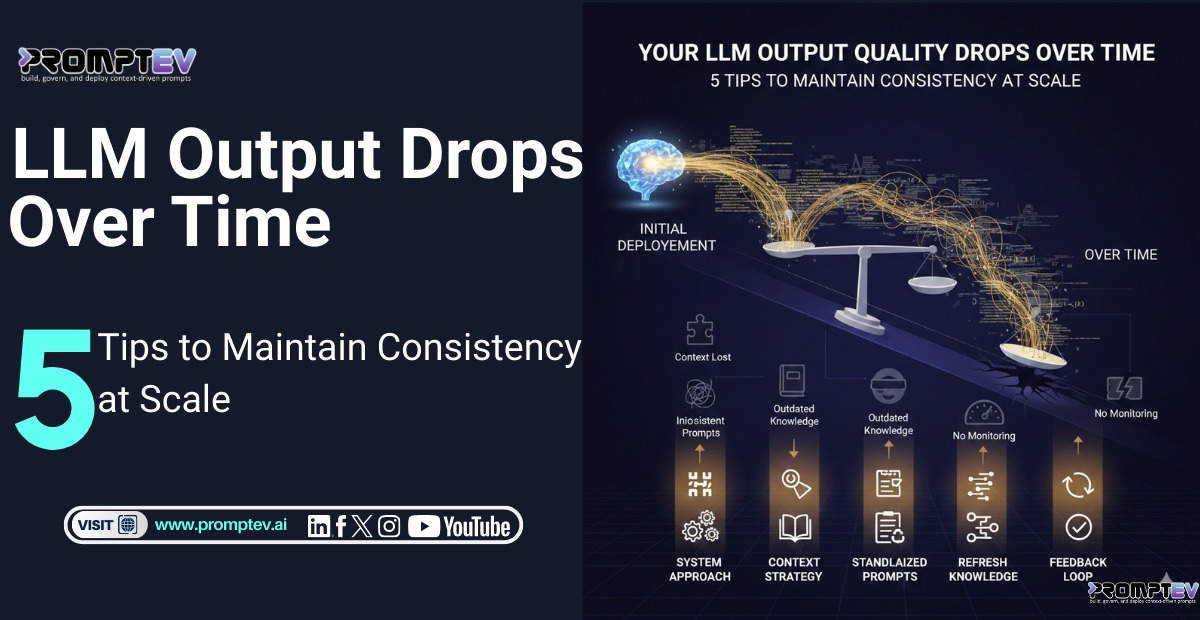
When you first deploy a Large Language Model (LLM), everything feels impressive. Responses are sharp. Accuracy is high. Teams are excited. But then, something changes. Over time, you start noticing inconsistencies. Quality drops. Responses feel weaker, repetitive, or even inaccurate. And suddenly, the tool that was meant to make work smarter starts creating frustration.
If you’re running AI at scale, this isn’t just an inconvenience. It’s a risk to productivity, customer trust, decision-making, and business performance. The good news? You can control it. But only if you understand why LLM quality drops over time and how to maintain stability.
In this article, you’ll learn exactly that.
5 Reasons: Why LLM Output Quality Drops Over Time
1. Context Gets Lost Over Time
LLMs perform best when they understand context. But when you scale, more users, more prompts, more knowledge sources, and more variations enter the system. Slowly, context clarity fades. When context weakens, quality drops.
2. Prompts Aren’t Designed for Scale
Your first few prompts feel perfect. But when multiple teams use the same system, they tweak, shorten, expand, and experiment. Over time, prompt discipline disappears. That leads to unpredictable outcomes and inconsistent performance.
3. Knowledge Base Changes
Your data never stays static. Policies change. Documentation updates. Product evolves. But your AI doesn’t magically adapt unless you design it to. If your knowledge pipeline isn’t continuously refreshed, your LLM begins answering with outdated or incomplete information.
4. Humans Start Trusting AI Too Much
This is a silent killer. Teams become comfortable. They stop reviewing responses. They stop validating. They assume “it’s AI, so it must be correct.” Errors slip through and propagate. Over time, quality isn’t just dropping; it’s influencing decisions.
5. Monitoring Doesn’t Exist
If you’re not measuring LLM performance, you can’t improve it. Most companies deploy AI but never build feedback loops, evaluation metrics, or quality dashboards. So quality issues go unnoticed until they become major problems.
5 Tips: How You Maintain LLM Quality Consistency at Scale (H2)
1. Treat AI Like a System, Not a Tool
You don’t just “install AI.” You build an ecosystem around it that supports reliability at scale. That ecosystem should include:
- Governance
- Version control
- Monitoring
- Update policies
- Clear workflows
When you treat AI like infrastructure instead of magic, it behaves predictably. Teams know how to use it, updates happen safely, and errors can be caught early.
2. Build a Strong Context Strategy
LLMs don’t just need information; they need the right information at the right moment. This means structuring knowledge sources intelligently, eliminating noise, prioritizing relevant context, and avoiding dumping unnecessary data.
A strong context strategy ensures your AI can reason effectively, giving consistent and accurate outputs even as your knowledge base grows.
3. Standardize Prompts
Random prompts lead to random outcomes. By standardizing prompts, you create predictable and reliable results.
Standardized prompts like through:
- reusable templates
- predefined structures
- role-based prompts
- scenario-specific guidance
Training teams to follow these standards prevents accidental mistakes and ensures that everyone is asking the AI the right way to get the right answers.
4. Continuously Refresh Knowledge
Your system should never become static. Build a pipeline where documentation updates automatically feed the AI, outdated data is removed, and new knowledge becomes instantly usable.
By keeping your knowledge base up-to-date, your LLM evolves alongside your organization, maintaining consistency and accuracy over time.
5. Build a Feedback & Evaluation Loop
To prevent silent quality decline, implement robust feedback and evaluation systems: collect user feedback, conduct human review, apply automatic scoring, and track accuracy and performance metrics.
This loop helps catch small issues before they become big problems, ensuring your AI stays reliable and aligned with user expectations.
Wrap Up
LLM output quality doesn’t decline by accident, it declines when you scale without a strategy. If you want real consistency, you need structure, governance, and continuous refinement. That’s where effective context engineering comes in. When AI systems are designed with the right context, you don’t worry about performance drop-off you scale with confidence.
FAQs
Q1: Why does LLM quality decline after deployment?
Because context weakens, prompts become inconsistent, data becomes outdated, and there is no monitoring or feedback loop.
Q2: Can you completely stop quality decline?
Yes you can, but with governance, context strategy, knowledge updates, and performance monitoring.
Q3: Is prompt engineering enough to maintain quality?
No. You need system design, not just better prompts.
Q4: Does scaling always reduce LLM quality?
Not if you scale with structure and controls.
Q5: What matters most for long-term consistency?
Context strategy and continuous monitoring matters most for ling-term consistency.

Faisal Saeed is Founder & CEO of Promptev, building next-gen context engineering infrastructure that enables teams to orchestrate, scale, and deploy production-ready generative AI systems with confidence.