From Lawyers to AI Operators: The Shift Happening Now In 2026
For decades, being a lawyer meant mastering legal knowledge, drafting documents, and manually reviewing contracts line by line. Your value was tied to how much information you could process and how precisely you could apply it.
But that definition is rapidly changing.
Today, you’re not just expected to know the law, you’re expected to operate systems that execute legal work. The rise of AI is shifting your role from a traditional legal expert to something more dynamic: an AI operator.
This doesn’t mean lawyers are becoming less important. In fact, your role is becoming more strategic. But the way you work, the tools you use, and the skills you need are evolving fast.
What Does “AI Operator” Actually Mean?
An AI operator isn’t someone who writes code or builds AI models from scratch. Instead, you’re someone who guides, manages, and oversees AI systems that perform legal tasks.
Think of it as a shift in responsibility.
Instead of doing everything manually, you:
- Set up workflows
- Define rules and guardrails
- Review AI-generated outputs
- Make final decisions
You’re no longer just executing legal work; you’re orchestrating it.
For example, rather than reviewing 100 contracts yourself, you configure an AI system to:
- Scan all contracts
- Flag risks
- Suggest edits
Then you step in to validate and finalize. This is the core of AI Operators in the legal Industry.
Why This Shift Is Happening Right Now
This transformation didn’t happen overnight. It’s being driven by very real pressures that you’re likely already facing.
Legal teams today are expected to:
- Handle more work with the same resources
- Deliver faster turnaround times
- Maintain strict compliance
- Support business teams in real time
At the same time, the complexity of legal work is increasing. Traditional ways of working simply can’t keep up.
This is where AI in Law Firms becomes essential. AI systems can process large volumes of data, identify patterns, and automate repetitive tasks, something that would take hours or days manually. As a result, your role naturally shifts from doing the work to managing how the work gets done.
The Evolution: From Manual Work to AI-Driven Operations
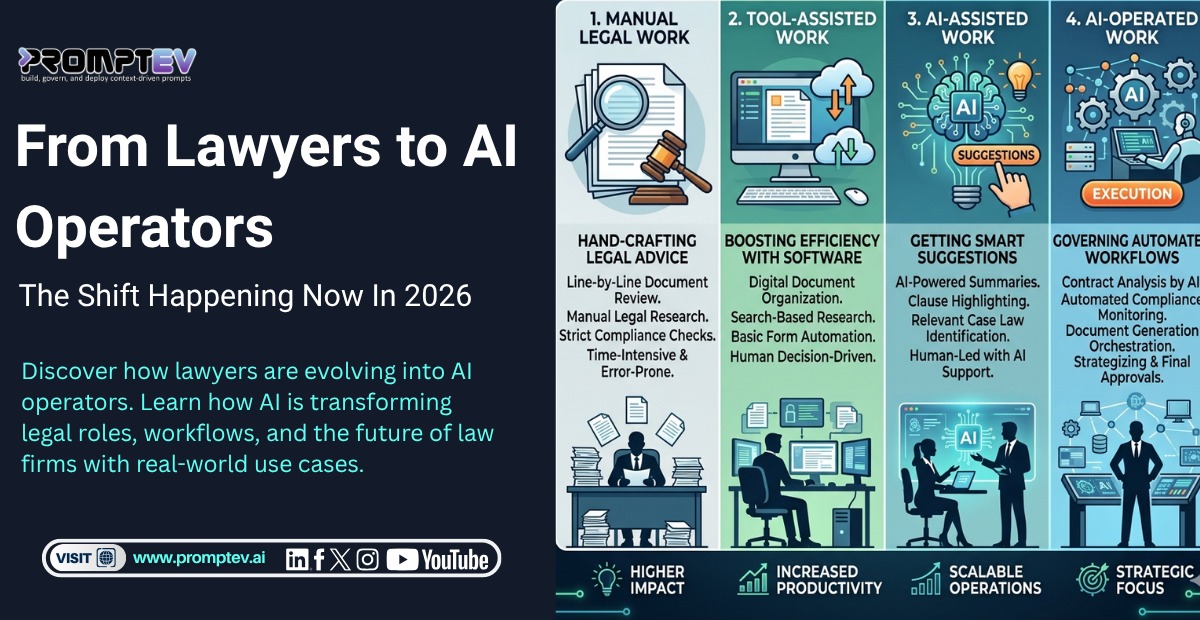
To understand how legal work is changing, you need to look at how workflows have evolved. This shift didn’t happen overnight. It moved step by step, from fully manual processes to systems where AI now handles execution.
Stage 1: Manual Legal Work
In the traditional model, everything depends on manual effort. You review contracts line by line, conduct legal research from scratch, and handle compliance checks without much support.
This approach gives you full control, but it also takes a lot of time and increases the chances of human error. As the workload grows, it becomes harder to maintain speed and accuracy.
Stage 2: Tool-Assisted Work
At this stage, you start using digital tools to support your work. Document management systems, legal research platforms, and basic automation tools help you stay organized and work faster.
However, these tools don’t think or act on their own. You still handle most of the decision-making and execution. They improve efficiency, but the workload is still largely manual.
Stage 3: AI-Assisted Work
Here, AI begins to play a more active role in your workflow. It helps you with suggestions, summaries, and insights that make your work easier and faster.
For example, AI can summarize long documents, highlight important clauses, or suggest relevant case laws. But you are still deeply involved in executing tasks and making final decisions. AI supports you—but doesn’t replace your effort.
Stage 4: AI-Operated Work
This is where the real transformation happens. AI systems don’t just assist—you let them handle execution. Tasks like contract analysis, compliance monitoring, and document generation can run automatically.
Your role shifts from doing the work to supervising and optimizing it. You focus more on strategy, risk assessment, and final approvals, while AI manages repetitive and time-consuming tasks in the background.
5 Benefits of Becoming an AI Operator
Adapting to AI-driven workflows is no longer just a trend; it’s a clear advantage. When you shift from manual execution to operating AI systems, you don’t just work faster—you work smarter and with more impact.
Increased Productivity
As an AI operator, you can handle a much higher volume of work in less time. Tasks that used to take hours, like document review, research, or drafting, can now be completed in minutes. This allows you to manage more cases and responsibilities without feeling overwhelmed.
Higher Impact
Instead of spending your time on repetitive tasks, you focus on work that truly matters. You can give more attention to strategy, decision-making, and complex legal thinking. This shift increases your value within the team and helps you contribute at a higher level.
Better Work-Life Balance
Manual legal work often leads to long hours and burnout. When AI handles repetitive tasks, your workload becomes more manageable. You spend less time on routine work and more time on meaningful tasks—both professionally and personally.
Competitive Advantage
Legal teams that adopt AI early move faster and deliver better results. By becoming an AI operator, you stay ahead of the curve and position yourself as someone who understands modern legal workflows. This gives you a strong edge in a rapidly evolving industry.
Scalable Legal Operations
With AI, growth doesn’t always mean hiring more people. You can scale your legal operations efficiently by automating repetitive processes. This allows your team to handle increased workload without constantly expanding resources.
AI Will Not Replace Lawyers
There’s a common fear that AI will replace lawyers. But the reality is different. AI handles repetitive, data-heavy tasks. You bring:
- Judgment
- Context
- Ethical reasoning
- Strategic thinking
Instead of replacing you, AI amplifies your capabilities. This is why the Future of Legal Jobs is not about elimination, it’s about evolution.

Summing Up
The shift from Lawyers to AI Operators is already happening, and it’s reshaping the legal industry at its core. By embracing AI and learning how to operate it effectively, you move beyond manual work into a role that is more strategic, efficient, and impactful. The future doesn’t belong to those who resist change—it belongs to those who adapt and lead it.
**FAQs
**1. What is an AI operator in the legal field?
An AI operator is a lawyer who manages and oversees AI systems that perform legal tasks.
2. Do lawyers need coding skills to become AI operators?
No, but understanding how to use and guide AI tools is essential.
3. Will AI replace legal jobs?
No, AI will automate tasks, but lawyers will remain essential for decision-making and strategy.
4. How can lawyers start using AI today?
By adopting AI tools for contract review, research, and workflow automation.
5. What is the biggest benefit of this shift?
The ability to focus on high-value work while AI handles repetitive tasks.

Faisal Saeed is Founder & CEO of Promptev, building next-gen context engineering infrastructure that enables teams to orchestrate, scale, and deploy production-ready generative AI systems with confidence.