9 Tips: How to Tune Retrieval Models for Best RAG Accuracy
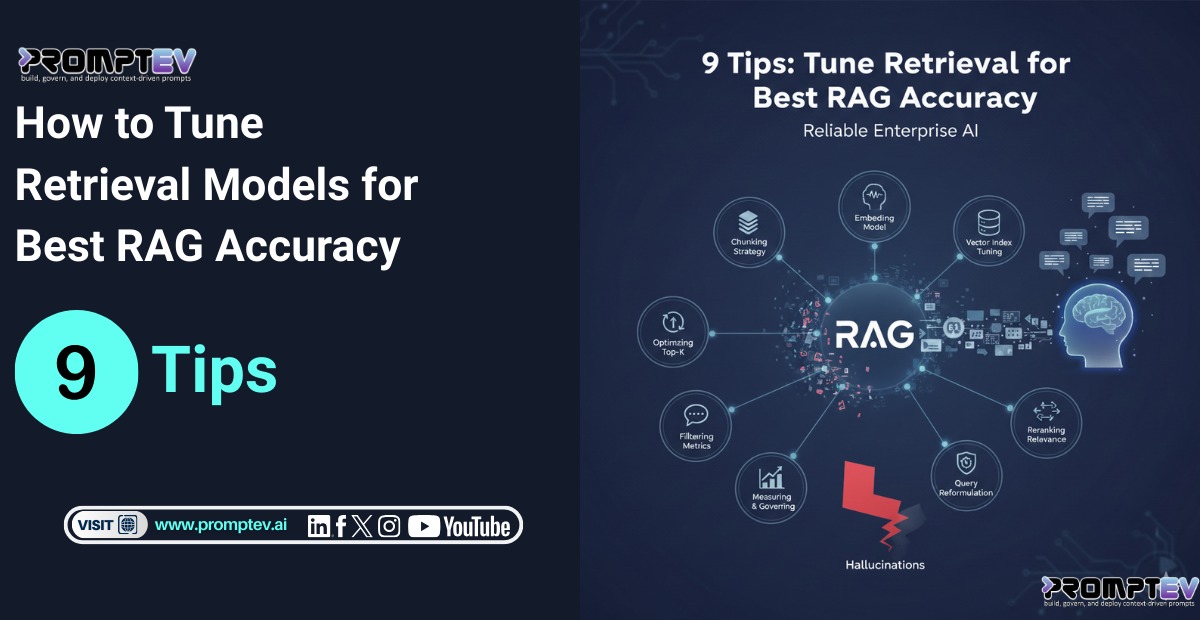
When you build a Retrieval Augmented Generation (RAG) system, accuracy does not come from the language model alone. It comes from whether the system retrieves the right context before generation begins.
Many RAG systems appear impressive during demos but fail in real usage. The reason is simple: retrieval was never tuned for real data, real users, or real complexity. When retrieval breaks, the LLM fills gaps with assumptions. That is why tuning retrieval models is not an optimization step. It is the foundation of building RAG systems that are reliable, scalable, and enterprise-ready.
In this article, we will explain how to tune retrieval models for the best RAG accuracy with 9 actionable tips.
Let’s start with a better understanding!
Why Retrieval Tuning Is Critical for RAG Accuracy
In a RAG pipeline, retrieval controls what the model is allowed to know. If the retrieved documents are incomplete or irrelevant, even the strongest LLM will produce incorrect answers.
This makes RAG fundamentally different from standalone LLM systems. Accuracy depends not only on reasoning ability, but on whether the correct information was retrieved at the right time.
Poor retrieval increases hallucination risk, reduces user trust, and creates unpredictable behavior. Strong retrieval, on the other hand, naturally leads to grounded and explainable answers.

9 Tips to Tune Retrieval Models for Best RAG Accuracy
1. Start With Correct Chunking Strategy
Chunking defines how your knowledge is represented during retrieval. If chunks are poorly designed, embeddings lose semantic clarity.
Large chunks dilute the meaning and remove unnecessary content. Very small chunks fragment context and remove essential relationships between ideas.
A well-tuned RAG system uses semantically meaningful chunks with controlled size and overlap. This ensures each chunk represents a complete idea while remaining retrievable with precision.
2. Choose the Right Embedding Model
Embedding models decide how well semantic similarity is captured. Using the wrong embedding model silently degrades retrieval quality.
General-purpose embeddings may work for simple datasets, but often struggle with technical, legal, or enterprise content. Domain mismatch leads to weak similarity scoring and missed context.
To achieve high RAG accuracy, embeddings must align with your data type, language, and domain. Accuracy should always be prioritized over cost at this stage.
3. Tuning the Vector Index for Accuracy
Vector databases are not accuracy-optimized by default. Index configuration directly affects recall and ranking quality.
Parameters such as distance metrics, index type, and search depth determine whether relevant chunks are surfaced or ignored. Default settings often trade recall for speed.
For RAG systems, recall matters more than latency during early tuning. A fast system that retrieves the wrong context will always fail.
4. Optimizing Top-K Retrieval
Top-K controls how many chunks are passed to the LLM. This decision has a direct impact on accuracy.
If K is too low, critical information may be missing. If K is too high, irrelevant noise can confuse the generation.
Top-K should be tuned empirically using real queries. The optimal value varies by domain, data complexity, and document structure.
5. Use Reranking to Improve Relevance
Initial retrieval retrieves candidates, not final answers. Reranking determines which context actually matters.
Reranking models score retrieved chunks against the query and reorder them based on relevance. This ensures the most useful information appears first.
In enterprise RAG systems, reranking significantly improves grounding and reduces hallucinations, especially when Top-K values are high.
6. Query Reformulation for Real User Behavior
Users rarely ask clean or complete questions. They assume context, use shorthand, and mix concepts.
Query reformulation helps the retrieval system compensate for this behavior. Techniques such as query expansion and multi-query generation improve recall.
Without reformulation, even well-tuned retrieval systems fail on ambiguous or underspecified queries.
7. Filtering and Governing Retrieved Context
Not all retrieved documents should reach the LLM. Unfiltered context introduces risk. Outdated documents, low-confidence sources, or irrelevant file types reduce accuracy and increase hallucination probability.
Metadata filtering ensures that only relevant, current, and authorized information is used during generation, improving both trust and compliance.
8. Measuring the Right Retrieval Metrics
You cannot tune retrieval without measuring it properly. Accuracy must be evaluated before generation.
Metrics such as Recall@K, Precision@K, and Mean Reciprocal Rank reveal whether retrieval is doing its job. These metrics show coverage, noise, and ranking quality. Generation metrics only make sense once retrieval quality is validated independently.
9. Continuous Tuning in Production
Retrieval tuning is not a one-time task. Data evolves, language changes, and user behavior shifts.
Without continuous evaluation, retrieval performance degrades silently. What worked at launch may fail months later.
Production-grade RAG systems continuously monitor retrieval quality and adapt as the knowledge base grows.

Final Word
High RAG accuracy does not come from better prompts or larger models. It comes from disciplined retrieval tuning.
When retrieval is tuned correctly, generation becomes reliable by design. Hallucinations decrease, trust increases, and business value emerges. Retrieval is not a supporting component of RAG. It is the system’s intelligence layer.
FAQs
1. Why does retrieval tuning matter more than the LLM in RAG?
Because the LLM can only reason over the retrieved context. Incorrect retrieval guarantees incorrect answers.
2. Can RAG systems still hallucinate after tuning retrieval?
Yes, but strong retrieval significantly reduces hallucination frequency and severity.
3. Is hybrid retrieval necessary for enterprise RAG?
Yes. Hybrid retrieval handles both semantic similarity and exact matching, which real enterprise data requires.
4. Should retrieval and generation be evaluated separately?
Absolutely. Mixing them hides root causes and slows down optimization.
5. How often should retrieval models be re-tuned?
Continuously, especially when documents, users, or business requirements change.

Faisal Saeed is Founder & CEO of Promptev, building next-gen context engineering infrastructure that enables teams to orchestrate, scale, and deploy production-ready generative AI systems with confidence.