How Promptev MCP Server Solves Tool and Context Chaos for AI Coding Teams
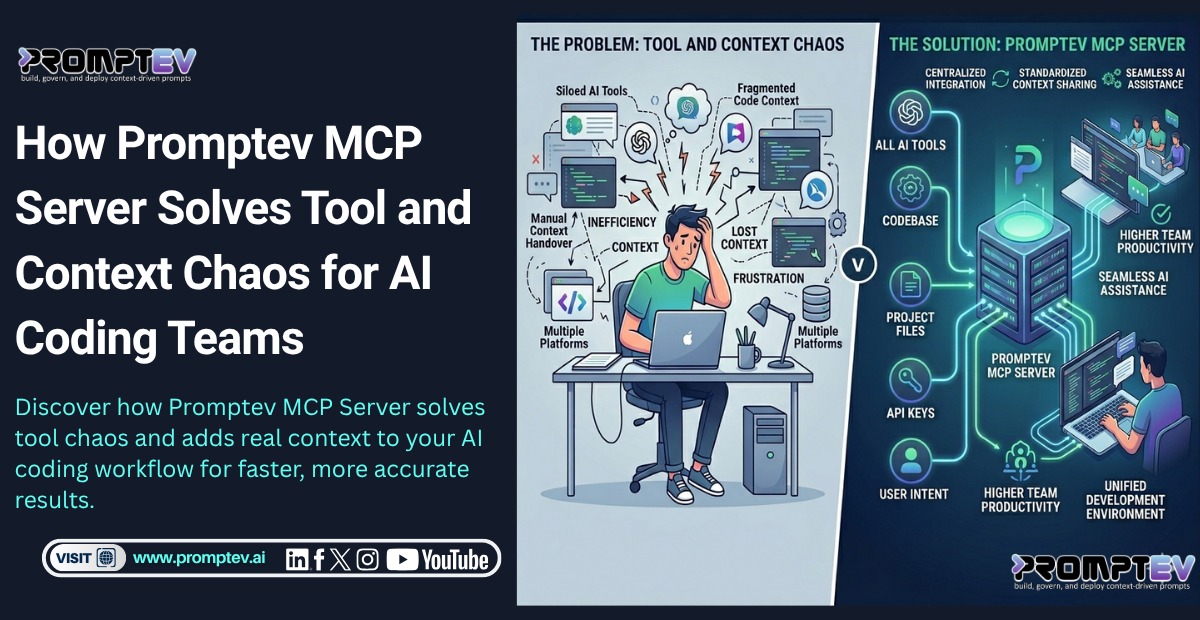
Every developer using AI coding tools hits the same wall. You start with one MCP server — maybe GitHub. Then you add Jira. Then Google Drive. Then Slack, Notion, Postgres, Gmail. Before you know it, you have 10 MCP servers configured, each with its own OAuth setup, API keys, and a local process that crashes every Tuesday.
This is tool chaos. And it’s only half the problem.
The other half? Your AI can use tools but doesn’t know your team. It can create a Jira ticket but doesn’t know your project’s architecture. It can send an email but hasn’t read the client’s requirements. It can query a database but doesn’t understand what the numbers mean. Tools without context produce garbage.
We built the Promptev MCP Server to solve both problems with one URL. Here’s how it works, why it matters, and what it looks like in practice.
The Three Problems Every AI-Native Developer Faces
1. Tool Chaos — Too Many MCP Servers
A typical developer’s MCP configuration in 2026 looks like this: GitHub MCP for code, Jira MCP for tickets, Google Drive MCP for docs, Slack MCP for messaging, Postgres MCP for data, Gmail MCP for email. Each one needs separate OAuth credentials, a running process, and maintenance when tokens expire.
One developer reported on GitHub having 32 MCP servers with 473 tools — burning 140,000 tokens just on tool definitions. That’s 70% of Claude’s context window gone before typing a single word.
Research confirms that 30 tools is the threshold where AI models start failing at tool selection. Above 100 tools, selection accuracy drops to near-zero. Most developers with 5+ MCP servers are already past the danger zone.
2. Context Chaos — Your AI Doesn’t Know Your Team
Individual MCP servers give your AI tools. But tools without knowledge are dangerous. Your AI can execute actions but can’t reason about whether those actions make sense for your specific project, team, or codebase.
What developers actually need isn’t just “call this API” — it’s “search our internal docs for the auth migration plan, then create a Jira ticket that references the right architecture decisions, then email the team lead with context.” That requires knowledge + tools, not just tools.
No existing MCP server for developers provides this. Composio has 850+ tools but zero knowledge search. Individual MCP servers are tool wrappers with no context layer. The gap between what developers need and what exists is massive.
3. Context Lock-In — Switch Tools, Lose Everything
Claude Code stores memory in local files on your machine. Cursor keeps context in their cloud. Codex has its own sandbox. Switch from one to another and everything resets.
Martin Fowler’s team calls this the “context engineering” problem. Stack Overflow describes it as “not a tools problem — it’s a governance problem.” The missing piece is a context engineering platform that works across all your AI tools, not just one.
One URL: How Promptev MCP Server Works
The Promptev MCP Server exposes your entire project — tools, integrations, and team knowledge — through a single MCP endpoint.
Setup takes 30 seconds:
{
  "mcpServers": {
    "promptev": {
      "type": "url",
      "url": "https://api.promptev.ai/mcp/YOUR_PROJECT_API_KEY"
    }
  }
}
No install. No npm. No local processes. No per-integration OAuth. Paste one URL into Claude Code, Cursor, Codex, Windsurf, or any MCP-compatible tool. Done.
Your AI coding tool now has access to:
- 233+ tools across 17+ integrations (Jira, Gmail, Google Drive, Slack, Notion, Dropbox, GitHub, databases, and more)
- Team knowledge search — intelligent retrieval across all your indexed documents, powered by Promptev’s Context Engine and Context Graph
- Custom HTTP tools — any REST API you’ve connected
- MCP passthrough — any external MCP servers you’ve added
- Database tools — PostgreSQL, MySQL, Oracle, SQL Server with natural language queries
Every call is tracked with a full audit trail — who called what, when, with what arguments, what was returned. Credits are metered per call. OAuth tokens are managed centrally and auto-refreshed.
Real-World Example: What We Actually Built With It
We didn’t just build the Promptev MCP Server — we used it. Here’s what happened in a single Claude Code session:
- Listed context packs — “What knowledge bases does this project have?” → 32 indexed context packs returned instantly
- Searched team knowledge — “What is Promptev?” → hybrid search across all packs, found the knowledge base doc and intro deck with relevant chunks and sources
- Listed Dropbox files — “What’s in our Dropbox?” → OAuth handled by Promptev, returned folders and files with metadata. No Dropbox MCP server installed locally.
- Uploaded session notes to Google Drive — Created a PDF summary and uploaded it via
gdrive_upload_file. No Google Drive MCP server configured. - Created a Google Doc — Combined 37 memory files into one appendable document via
gdocs_create_document. - Sent an email — Composed and sent an email via
gmail_send_email. OAuth handled by Promptev, no Gmail MCP server. - Updated a knowledge base on OneDrive — Read a file, added new content, wrote it back via
onedrive_update_file.
Seven different integrations. One MCP URL. Zero local configuration. Every action logged, credited, and auditable.
Sessions as Context Packs: The Memory Portability Breakthrough
Here’s where it gets interesting. During development, we realized that Claude Code’s local memory files — session notes, project decisions, architecture research, feedback — are exactly the kind of knowledge that should be searchable by the entire team.
So we did something simple:
- Exported all 39 local memory files
- Uploaded them to a Google Drive folder via the Promptev MCP Server
- Attached that folder as a Context Pack in Promptev
- Now any AI tool connected via MCP can search those memories
The result: 38 documents indexed with Graph RAG — 1,578 entities, 212 relationships, 77 communities. Every past decision, bug fix, architecture choice, and research finding is now searchable from any coding tool.
“What security fixes were made last week?” — returns the exact session with commit SHAs, file changes, and reasoning.
“How does the freight procurement agent work?” — finds the case study, architecture decisions, and implementation details.
“What did we decide about the context engine?” — surfaces the graph RAG research, entity extraction benchmarks, and design decisions.
Local memory became team knowledge in one command. The AI coding tool that wrote the code can now search its own history — and so can every other tool and team member.
Why This Beats Individual MCP Servers
| Capability | 10 Individual MCP Servers | Promptev MCP Server |
|---|---|---|
| Setup time | Hours (per developer) | 30 seconds |
| Tools available | Per-server | 233+ from one URL |
| Knowledge search | None | Hybrid or Graph based search across all team docs |
| OAuth management | Per-server, per-developer | Centralized, auto-refresh |
| Team sharing | Each person configures separately | One URL for entire team |
| Tool switching | Reconfigure everything | Same URL in any tool |
| New team member | Days of setup | Paste URL, done |
| Audit trail | None | Every call logged |
| Context window usage | Each server adds tool definitions | One server, managed tool count |
| Maintenance | 10 processes to keep alive | Zero (hosted) |
Why This Beats Composio and Other Unified Tools Platforms
Composio has 850+ integrations. Nango has 700+ APIs. Pipedream has 2,800+ apps. They’re all excellent at tool access.
None of them have a knowledge layer.
Promptev’s context engineering platform combines tools with a multi-layered retrieval engine and a Context Graph that maps entities, relationships, and communities across your documents. Your AI doesn’t just keyword-match — it navigates your company’s knowledge structure. When your AI uses a tool through Promptev, it can first search your docs and traverse your knowledge graph to understand context — then act with full information.
This is the difference between “create a Jira ticket” and “create a Jira ticket that references the auth migration plan from our architecture docs, assigns it to the right person based on our team structure, and includes the acceptance criteria from the product spec.” The second one requires knowledge + tools. Only a unified MCP server with a context engine can do this.
The Context Window Efficiency Argument
Every MCP server you add loads its tool definitions into your AI’s context window. With 10 servers and 100+ tools, you can lose 50-70% of your context window to tool descriptions before you even start working.
Promptev’s approach is different. Instead of dumping your entire knowledge base into the context window, the Context Engine retrieves only what’s relevant per query. Ask about authentication? You get the 5 most relevant chunks from your docs — not 50 files. The Context Engine ensures high relevance with minimal token usage.
This means your AI spends its context budget on actual reasoning, not on reading irrelevant documents. It’s the difference between giving someone a library card and dumping 1,000 books on their desk.
Getting Started
The Promptev MCP Server is included on every plan, including Free (500 credits/month). Setup:
- Sign up at app.promptev.ai (free, no credit card)
- Connect integrations — Google, Jira, Slack, or whichever tools your team uses
- Create context packs — upload docs or connect cloud storage
- Generate API key — Project Settings → API Keys
- Paste URL into your coding tool’s MCP config
Five minutes. One URL. Every tool and every document, accessible from any AI coding tool your team uses — today and whatever comes next.
What to Say to Your AI Once Connected
Once configured, you don’t need to learn new commands or syntax. Just talk to your AI naturally — it sees Promptev’s tools like any other MCP tool. Here’s what you can try right away:
Search your team’s knowledge
- “Search our docs for the authentication migration plan”
- “What does our return policy say about international orders?”
- “Find the architecture decision about the payment gateway”
Your AI calls the Context Engine, retrieves the most relevant chunks from your indexed documents, and answers with sources — without you loading a single file into context.
Use any connected integration
- “Check Jira for open bugs assigned to me”
- “Send an email to the team with this week’s progress update”
- “Upload this summary to Google Drive”
- “What’s in our Dropbox shared folder?”
- “Create a Notion page with these meeting notes”
- “Post a message in the #engineering Slack channel”
Your AI picks the right tool automatically. You never need to remember tool names or parameters — just describe what you want in plain language.
Combine knowledge + tools in one request
- “Search our docs for the Q3 roadmap, then create a Jira epic with the top 3 priorities”
- “Look up the client’s requirements from our specs, then draft an email response”
- “Check what changed in our Google Drive this week and write a summary to Slack”
This is where the real power shows — your AI searches your knowledge base for context, then uses tools to take action. Knowledge + tools in one flow, one MCP connection.
Discover what’s available
- “List my context packs” — see all indexed knowledge bases
- “What tools do you have access to?” — your AI lists everything available through Promptev
Key Takeaways
- Tool chaos is real — 10+ MCP servers with separate OAuth, processes, and maintenance is unsustainable
- Context chaos is worse — tools without knowledge produce wrong results. Your AI needs your team’s docs, not just API access
- One URL replaces everything — 233+ tools, team knowledge, centralized OAuth, audit trail, credit tracking
- Sessions become context packs — local memory from any AI tool can be indexed and searched by the entire team
- Context follows you — switch Cursor → Claude Code → Codex, same URL, same knowledge
- Search, don’t dump — context engine retrieves relevant chunks instead of filling the context window
Ready to replace your MCP server sprawl? Start free on Promptev — all features included, no credit card required. One URL for your entire team.

Faisal Saeed is Founder & CEO of Promptev, building next-gen context engineering infrastructure that enables teams to orchestrate, scale, and deploy production-ready generative AI systems with confidence.