How Context Engineering Improves AI Workflow Accuracy
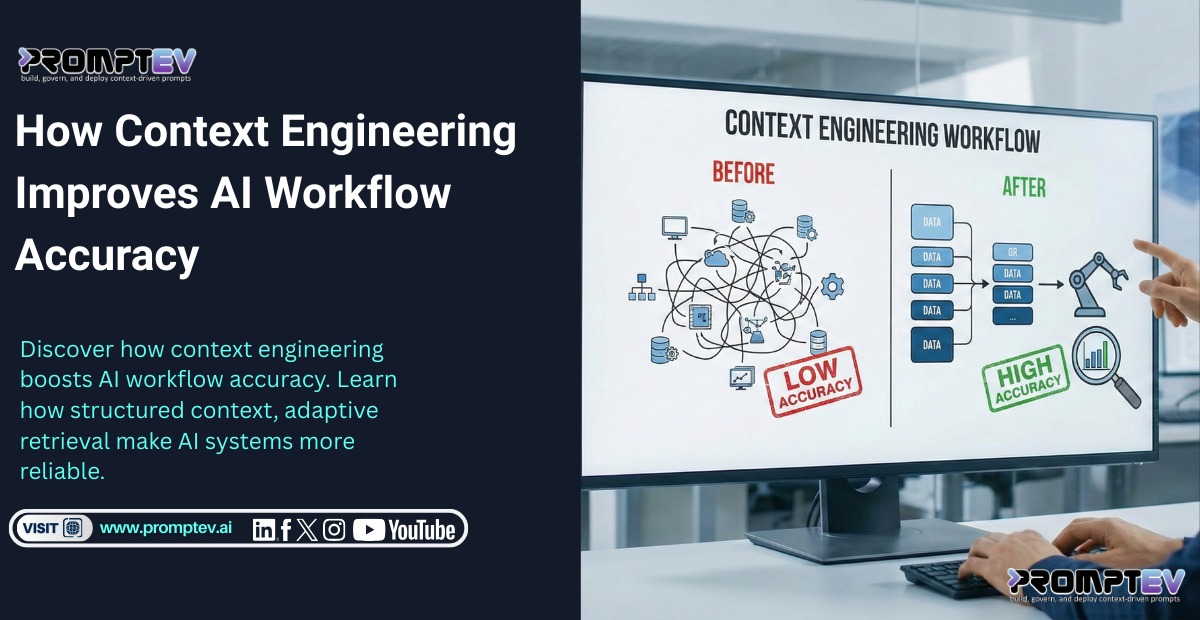
AI systems have become a core part of business operations, but even the best models still make mistakes. They forget earlier instructions, drift off-topic, or generate information that wasn’t provided.
The reason for these errors is simple: AI doesn’t naturally manage context.
It reacts only to what it sees at a given moment. That’s where context engineering changes the game. It provides AI with structured and intelligently organized information to improve accuracy
This article explains how context engineering enhances AI workflow accuracy and transforms unpredictable AI behaviour into predictable.
Let’s have a look!
What Is Context Engineering?
Context engineering organizes the information in an AI system according to rules, memory, instructions, knowledge, and workflow logic. Instead of feeding AI scattered prompts, context engineering builds a structured environment where AI always knows what to follow, what to reference, and how to act.
10 Ways: How Context Engineering Improves AI Workflow Accuracy
Prevents AI From Forgetting Critical Instructions
As you know, large language models forget earlier instructions as a conversation becomes longer. This leads to inconsistent results, missing details, or outputs that don’t follow the original requirements. Context engineering prevents this by pinning important rules and maintaining a stable instruction layer. This ensures that no matter how long the workflow runs, the AI produces consistent outputs.
Reduces Hallucinations
Hallucination is one of the biggest challenges in AI workflows. When the model doesn’t have enough relevant information, it guesses. Those guesses often turn into inaccurate responses. Context engineering solves this by supplying the AI with verified knowledge. Instead of guessing, the AI relies on high-quality context that has been intentionally structured for accuracy. This produces grounded results.
Keeps Workflow Steps Clear
AI often jumps steps, merges steps, or follows instructions loosely. In workflow automation, even one skipped step can break an entire process. But context engineering brings order by defining each step clearly and maintaining workflow logic. This results in predictable behaviours, fewer errors, and smooth workflows.
Brings Domain Expertise Into the AI
The accuracy of any AI system increases when it understands the industry it’s working in. Context engineering introduces domain-specific guidelines, terminology, frameworks, and rules directly into the AI’s environment. This way, AI starts responding like a subject-matter expert. So, you get improved results in every field, such as finance, healthcare, customer support, legal, etc.
Improves Reasoning Across Multiple Documents
AI struggles when it needs to connect information across long documents. It may miss key details out of context. Context engineering strengthens multi-document reasoning by indexing knowledge and storing it in structured layers. So, it pulls the right information at the right time.
Ensures a Single Source of Truth
Businesses often store information in different places, such as documents, chat history, product pages, internal notes, and team instructions.
When the AI receives conflicting information, accuracy drops. Context engineering organizes and prioritizes all of this knowledge, ensuring the AI follows a single, unified source of truth. This eliminates contradictions and keeps outputs aligned.
Enables Accurate Real-Time Decisions
Many business systems depend on real-time accuracy, such as customer support, operational workflows, AI agents, and automated pipelines. When it comes to context, it equips AI with the right information instantly. This thing allows for making accurate decisions in fast-moving situations. This reduces wrong assumptions and time-wasting errors.
Scales AI Workflows Without Adding Errors
As businesses expand their AI usage, workflows become more complex. More instructions. More data sources. More steps. Without structure, accuracy collapses. Context engineering organizes growing knowledge and maintains clean context layers. It also updates versions and ensures AI systems continue to perform even as the environment scales. This allows teams to grow without increasing error rates.
Improves Collaboration Between Multiple AI Agents
Modern AI systems rely on multiple agents working together. Each of them handles part of a large workflow. Agents misunderstand each other’s outputs without shared context. But the context engineering synchronizes instructions, memory, and rules across all agents. This thing creates coherent collaboration and reduces communication errors.
Lowers Human Review Time
When AI makes fewer mistakes, teams spend less time editing, correcting, or re-running outputs. Context engineering dramatically reduces the need for manual oversight because the AI becomes more disciplined and reliable. This leads to faster workflows and lower operational costs.
Final Word
AI accuracy is not achieved by prompts alone. It requires a structured, organized, and intelligently managed context. Context engineering provides that foundation. It turns AI from a reactive tool into a reliable system that follows rules, respects workflows, understands domain knowledge, and delivers consistent results at scale.
For any business that depends on AI for operations, context engineering is no longer optional. It is the key to unlocking accuracy, stability, and real-world performance.
FAQs
What is context in AI workflows?
It refers to instructions, data, rules, and memory that the AI uses to operate accurately.
Why do LLMs make mistakes without structured context?
Because they rely on pattern prediction, not memory, process logic, or rules.
Can context engineering reduce hallucinations?
Yes. Structured knowledge and restricted retrieval reduce hallucinations.
Is context engineering only for large companies?
No, even small and medium-sized companies benefit from improved accuracy and consistency.
Does context engineering replace prompt engineering?
No, it enhances it. Prompt engineering is a part of the bigger context system.

Faisal Saeed is Founder & CEO of Promptev, building next-gen context engineering infrastructure that enables teams to orchestrate, scale, and deploy production-ready generative AI systems with confidence.