How to Evaluate RAG Systems Using Benchmarks Like MS-MARCO and Natural Questions
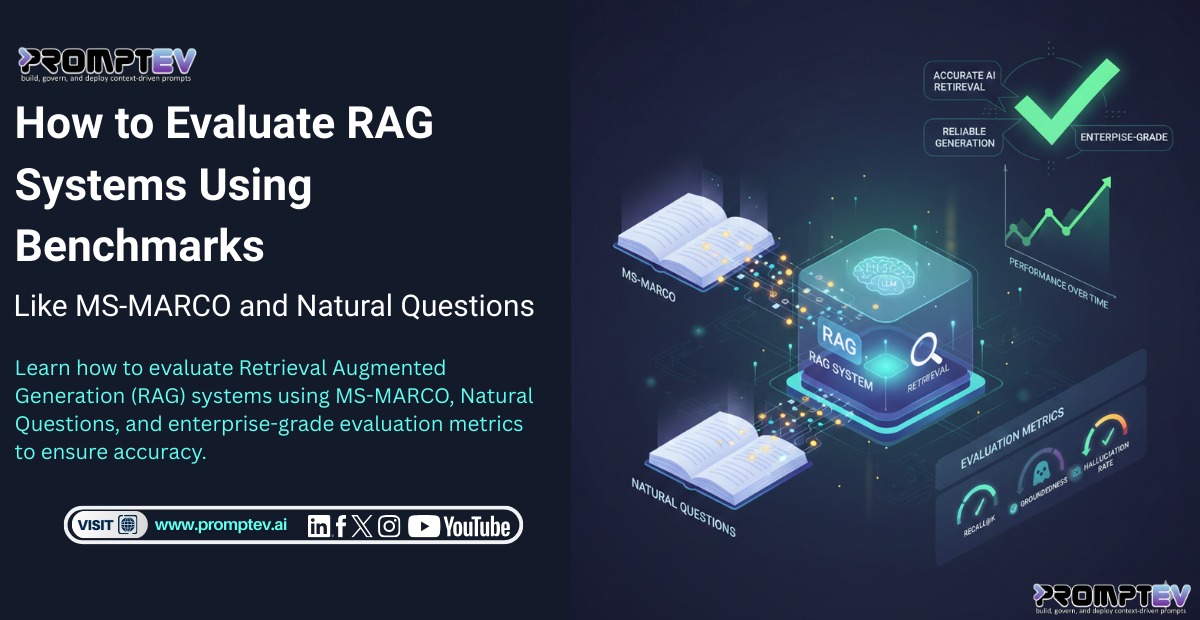
When you build a Retrieval Augmented Generation (RAG) system, the most important question isn’t “Can it answer questions?”, the real question is “Can it answer correctly and reliably, every single time?”
That reliability comes from evaluation. Without proper evaluation, your system might look impressive in demos but fail in real-world usage when real users start asking unpredictable questions.
That’s why industry-standard benchmarks like MS-MARCO and Natural Questions are widely used to measure performance.
Why RAG Evaluation Is Different?
Evaluating a normal LLM is straightforward; you mostly look at fluency, coherence, grammar, and reasoning ability. But RAG systems introduce a second moving part: retrieval.
This means:
- Even the strongest LLM will hallucinate if the retrieval is wrong.
- Evaluation must separately check retrieval AND generation.
- A system that appears promising on paper may still fail if the underlying context is weak.
So evaluation helps you measure not just “how beautifully it writes” but how factually correct and trustworthy it is.
Understanding MS-MARCO
MS-MARCO consists of real-world search queries taken from Bing. That means the dataset reflects how actual people ask questions, messy, short, or incomplete. This makes it perfect for testing how well RAG can handle realistic scenarios instead of perfectly structured academic questions.
It helps you understand:
- Can your system retrieve correct passages?
- Can it deal with vague human intent?
- Can it handle typical business-like user queries?
If your RAG performs well on MS-MARCO, it means it is good at everyday user-facing scenarios like customer support, knowledge assistants, chatbots, and search-based queries.
Understanding Natural Questions (NQ)
Natural Questions comes from real Google user queries and is considered more complex than MS-MARCO. Instead of short, simple questions, many queries involve deeper reasoning and require multi-step understanding.
This dataset helps evaluate whether your RAG can:
- Handle complex knowledge lookups
- Answer layered or multi-step questions
- Work effectively for research, enterprise knowledge base, and analytical tasks
So, if you are building enterprise assistants, internal knowledge tools, or advanced AI research systems, performing well on Natural Questions is a strong indicator of robustness.
Key Metrics to Evaluate RAG Systems
You cannot rely on a single metric to decide whether your RAG works or not. Different metrics tell different stories.
Retrieval Metrics
These metrics test whether your system is even giving the LLM the right information to work with.
1. Recall@k
This shows whether relevant information appears within the top “k” retrieved results. Higher recall means your system is less likely to hallucinate because useful data is usually present.
2. Precision@k
This measures how many retrieved results are actually useful. If you retrieve many irrelevant documents, your LLM may still get confused.
3. MRR
This tells how quickly the system finds relevant information. If correct answers always appear late in ranking, your system is inefficient.
These metrics reveal whether retrieval quality is strong enough to support accurate answers.
Generation Metrics
Once retrieval is correct, the next step is checking whether the LLM actually uses the information properly.
1. Groundedness
Does the answer strictly rely on retrieved information? If answers contain content outside the context, hallucination risk increases.
2. Exact Match & F1 Score
These compare the system’s answers to ground truth. Higher scores mean better accuracy.
3. Hallucination Rate
Lower hallucination means the system is safer for enterprise use. Together, these metrics help you see if your RAG is reliable, safe, and business-ready.
Reality Check: Benchmarks Alone Are Not Enough
Benchmarks are excellent starting tools. But they are still test environments. Real enterprise environments involve PDFs, compliance docs, legal files, SOPs, HR manuals, product knowledge, and constantly changing information.
So, you must combine:
- Industry benchmarks
- Real internal datasets
- Live user testing
That’s why platforms like Promptev focus on context engineering, ensuring your AI works even in messy, dynamic enterprise environments.
6 Best Practices to evaluate RAG
To evaluate a RAG system properly, you shouldn’t rely on a single dataset or single metric. A strong evaluation strategy always looks at multiple angles.
Here’s how to do it right:
1. Use Both MS-MARCO and Natural Questions
Relying on a single dataset provides only a limited view of your RAG system’s performance. MS-MARCO allows you to evaluate how your system handles real-world search-style queries, while Natural Questions helps assess performance on more complex, reasoning-based questions. Using both datasets ensures a comprehensive evaluation across different types of queries.
2. Separate Retrieval and Generation Evaluation
Many teams make the mistake of judging the entire RAG system with a single metric. Avoid this approach. Evaluate retrieval separately using metrics such as Recall, MRR, and Precision, and evaluate generation independently using metrics like Faithfulness, Exact Match (EM), and F1 score. This separation helps you identify whether issues originate from retrieval or the LLM itself.
3. Track Grounding Accuracy
Even if retrieval is strong, the model may not always use the retrieved information correctly. Tracking grounding accuracy ensures that the generated answers strictly rely on the retrieved context, minimizing hallucinations. This is especially critical in enterprise environments where accuracy and reliability are essential.
4. Test on Your Own Business Data
Benchmarks are helpful, but real customers do not operate on benchmark datasets. They query your actual documents, PDFs, SOPs, policies, and internal knowledge bases. Testing with your own business data ensures that the system performs well in real-world scenarios and is ready for practical deployment.
5. Continuously Monitor Performance
A RAG system is not a one-time deployment. Data evolves, products are updated, and regulations change. Continuous monitoring ensures that your system maintains accuracy over time and prevents performance degradation.
6. Involve Human Review Where Necessary
For high-stakes environments such as healthcare, legal, compliance, or finance, involving humans in the loop is crucial. Human feedback improves system performance, ensures correctness, and builds trust in your AI deployment.
Final Word
Good RAG systems are not built accidentally; they are designed and evaluated carefully. MS-MARCO and Natural Questions give you a powerful benchmarking foundation, but true reliability comes when you combine benchmarks with smart context management and continuous improvement strategies powered by platforms like Promptev.
FAQs
1. Is MS-MARCO enough to evaluate RAG?
No. While MS-MARCO is an excellent benchmark for evaluating retrieval and passage ranking, it only provides a partial view of your system’s performance. To get a complete picture, you should also test with Natural Questions and domain-specific datasets.
2. Do RAG systems hallucinate?
Yes. RAG systems can produce hallucinations, especially when the retrieval component fails to fetch accurate context.
3. Which metric matters most?
Recall@k and Faithfulness are critical metrics. Recall@k ensures that relevant documents are retrieved within the top results, while Faithfulness confirms that the generated answer is actually grounded in the retrieved content.
4. Should we evaluate retrieval separately?
Absolutely. Evaluating retrieval and generation together can hide underlying problems. By measuring retrieval independently with metrics like Recall, MRR, and Precision, you can diagnose whether issues originate from the retrieval step or the LLM’s generation process.
5. Can enterprise teams rely on benchmarks alone?
No. Benchmarks provide a controlled testing environment but do not reflect the full complexity of real enterprise data.

Faisal Saeed is Founder & CEO of Promptev, building next-gen context engineering infrastructure that enables teams to orchestrate, scale, and deploy production-ready generative AI systems with confidence.