Context Layer vs Knowledge Graph vs RAG: What’s the Difference?
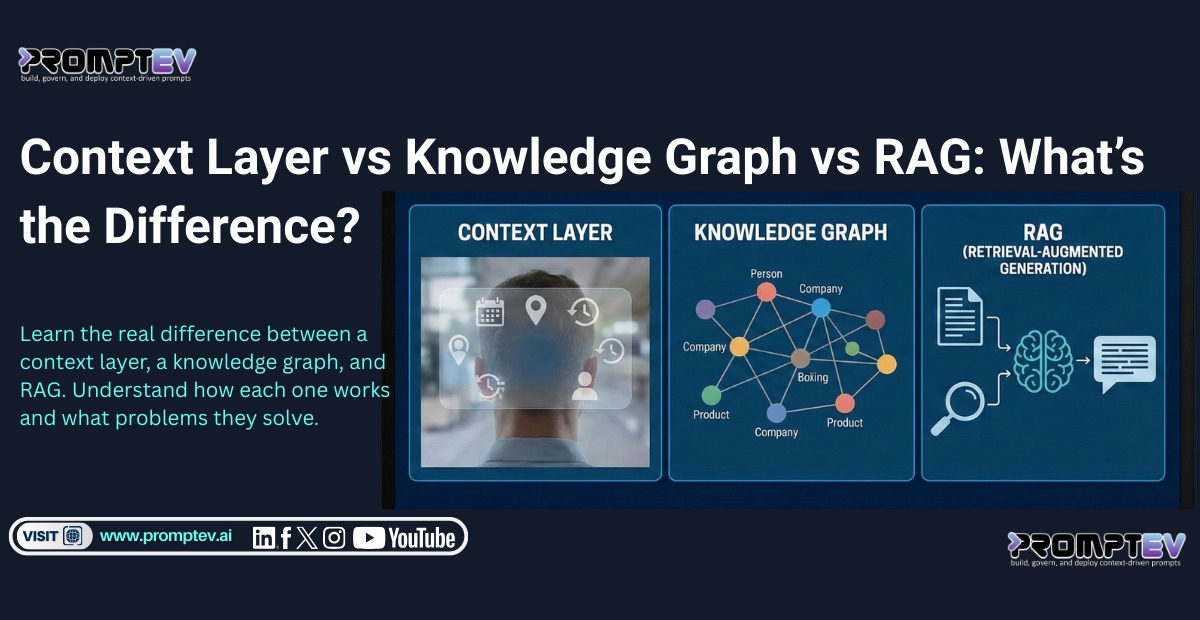
As companies start building AI assistants and automation tools, they realize that “just adding an LLM” is not enough. AI needs a proper structure. It needs memory and rules. Plus, it also requires reliable access to information.
This is where three important components enter the conversation: the context layer, the knowledge graph, and RAG.
Even though people often mix them up, they serve very different purposes. Each one solves a unique problem inside an AI system, and when combined within a well-designed context engineering platform, they create a far more intelligent and efficient workflow.
To understand which one you need (and why), let’s break down how they work in a simple, descriptive way.
What Is a Context Layer?
A context layer is the environment where an AI system receives its core instructions, rules, memory, and workflow logic. It doesn’t store raw data like a database, and it doesn’t map relationships like a graph. Instead, it tells the AI how to behave and what principles to follow in every situation.
The context layer defines things such as:
- AI’s tone and role
- How it should process tasks
- What it must prioritize
- What rules it cannot break
- Long-term memory
- Instructions that persist across interactions
- Specific business logic or workflow steps
Imagine hiring a new employee. You wouldn’t just hand them documents; you would teach them how your company works, how to communicate, what rules to follow, and what mistakes to avoid. The context layer plays the same role for AI.
What Is a Knowledge Graph?
A knowledge graph is a structured map of information. Instead of storing data in long documents, a knowledge graph organizes knowledge as connected nodes, showing how concepts relate to one another.
This structure allows AI to understand:
- How ideas connect
- How one piece of information depends on another
- Which relationships matter
- What belongs under which category
- What leads to what
For example, in an e-commerce company, a knowledge graph might connect:
Product → Category → Materials → Compliance Rules → Shipping Restrictions
In a healthcare environment, it might represent:
Symptom → Condition → Medication → Dosage → Contraindications
Because of this relational structure, knowledge graphs help AI reason more like a human. They give the model a logical map instead of leaving everything scattered across documents.
What Is RAG (Retrieval-Augmented Generation)?
RAG is a system that retrieves information from external sources and feeds it to the AI in real time.
Instead of relying only on what the model was trained on, RAG allows the AI to search internal documents, knowledge bases, help centers, PDFs, or websites and then generate answers based on what it finds.
RAG is useful for:
- Answering product questions
- Retrieving policy documents
- Searching company files
- Giving up-to-date answers
- Referencing long or technical texts
However, RAG does not add structural behavior. It simply retrieves text and passes it forward. The AI still needs a context layer to know how to use that information properly.
You can think of RAG as the AI’s “document search engine”; it provides raw information but not rules or understanding.
The Real Difference: Three Layers, Three Purposes
The key to understanding these systems is recognizing that they operate on different levels.
-
The context layer shapes behavior. It controls how the AI responds, how it follows rules, and how it maintains consistency.
-
The knowledge graph structures meaning. It teaches the AI how information is connected and how it should think.
-
RAG supplies facts. It gives the AI the source material it needs at the moment of answering.
They are not replacements for each other; they are complementary. Each solves a different piece of the accuracy problem.
When Do You Need Each One?
You turn to a context layer when you need predictable workflows, stable behavior, and AI that follows rules without drifting. Any system meant for production needs this.
You rely on a knowledge graph when your domain is complex and depends on relationships such as regulations, product structures, technical documentation, or scientific knowledge.
You implement RAG when your information exists mostly in documents, changes frequently, or must be referenced directly.
Most real-world AI systems use all three, but the context layer is what makes the entire system usable, safe, and reliable.
Conclusion
Context layers, knowledge graphs, and RAG are not competing ideas. They serve different functions inside a modern AI architecture. The context layer is the AI’s operating system.
The knowledge graph is its understanding of relationships. RAG is its gateway to external knowledge. Together, they unlock accuracy, consistency, and true intelligence inside AI workflows.
FAQs
1. What is the main difference between a context layer and a knowledge graph?
A context layer prepares the right information for an AI model during a task, while a knowledge graph is a structured database showing relationships between entities.
2. Why isn’t RAG enough for complex enterprise use cases?
RAG retrieves documents but doesn’t manage instructions, business rules, or conversation history. It can pull relevant text, but it can’t ensure the output follows workflows; that’s where the context layer fills the gap.
3. Can a context layer use both knowledge graphs and RAG together?
Yes. A context layer can orchestrate multiple sources such as RAG, knowledge graphs, memory, rules, and tools, and decide what the model needs at each step.
4. Which one should a business implement first: RAG, knowledge graph, or context layer?
Most businesses start with RAG because it’s simpler, then add knowledge graphs for structure, and finally implement a context layer for scalable.
5. How does a context layer improve model accuracy compared to RAG alone?
A context layer filters, ranks, and assembles only the most relevant instructions, memory, and data for each task. This prevents hallucination, reduces irrelevant retrieval, and ensures the model outputs are compliant.

Faisal Saeed is Founder & CEO of Promptev, building next-gen context engineering infrastructure that enables teams to orchestrate, scale, and deploy production-ready generative AI systems with confidence.