Is Context Engineering Worth the Cost? A Practical ROI Breakdown
You’ve probably heard promises about AI transforming your business. Every business owner wants faster decisions and automated workflows in their organization. But when budgets enter the conversation, one question becomes unavoidable: Is context engineering worth the cost?
You don’t invest in technology for hype. You invest for a measurable return. If context engineering is just another expensive AI layer, it’s not worth it. But if it turns scattered enterprise data into operational intelligence, the economics change.
In this guide, you’ll see a practical breakdown of where the cost sits, where the return appears, and how to evaluate the investment.

What Context Engineering Means
Context engineering is not simply AI integration. It is the layer that allows AI to understand how your organization works, your systems, data relationships, workflows, and operational priorities. Without this layer, AI behaves like a smart assistant with no onboarding. It can respond, but it lacks situational awareness.
On the other hand, with context engineering in place, AI becomes context-aware. It understands dependencies, retrieves relevant information instantly, and supports real decisions.
Remember, you’re not buying intelligence alone. You are buying usable intelligence embedded inside your workflows.
The Real Cost of Context Engineering
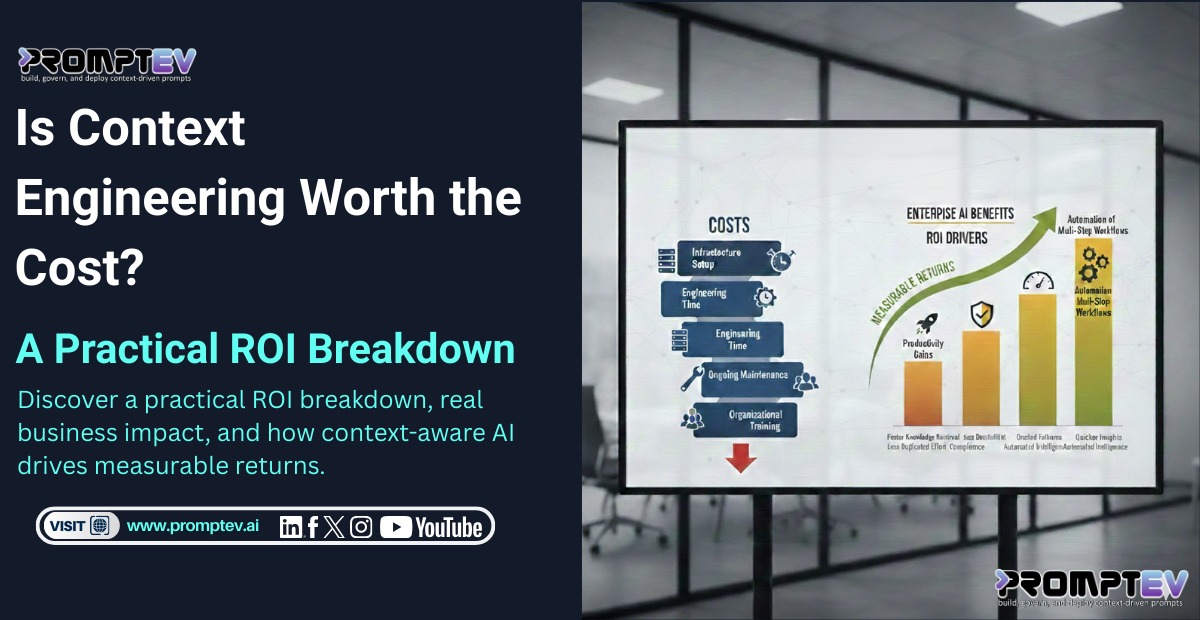
The investment feels heavy because it touches multiple operational layers at once. Most costs fall into four practical areas.
Infrastructure Setup
You invest in data connectors, pipelines, governance layers, and integration frameworks that allow AI to safely access enterprise systems. This foundation prevents chaos. Without structured infrastructure, AI produces inconsistent outputs instead of reliable intelligence.
Engineering Time
Teams must map data relationships and workflow logic. This is the design phase where your organizational knowledge is translated into a machine-readable structure. It is labor-intensive, but this is where long-term value is created.
Ongoing Maintenance
Context evolves with your company. New tools are added, policies change, and processes shift. Continuous monitoring and updates ensure your intelligence layer remains accurate instead of drifting out of sync.
Organizational Training
Adoption determines ROI. Employees must understand how to work alongside context-aware systems. Without training and cultural alignment, even the best architecture underperforms.
Where the ROI Comes From
Context engineering does not generate returns by existing. It generates return by reducing friction and accelerating decisions across your organization.
The value appears in several compounding areas.
ROI Driver #1: Productivity Gains
Every company pays a hidden tax called information search. Employees spend hours locating documents, confirming context, and coordinating across departments before acting. That delay scales silently across payroll.
Context-aware AI collapses this search layer. Employees move directly from question to insight. Over time, organizations often report:
- Faster knowledge retrieval
- Less duplicated effort
- Shorter coordination cycles
- Quicker onboarding for new hires
- Time saved converts directly into financial efficiency
ROI Driver #2: Error Reduction
Complex workflows increase the risk of blind spots. Missed compliance steps, misinterpreted data, or incomplete context can create expensive consequences.
Context engineering reduces this exposure by ensuring AI cross-checks dependencies and flags anomalies early. Prevention rarely feels dramatic, but financially, it matters. A single avoided regulatory or operational failure can offset a significant portion of system cost.
ROI Driver #3: Decision Acceleration
Speed is a competitive asset. When leaders wait days for fragmented analysis, opportunities fade. Context-aware AI compresses decision cycles by assembling relevant information instantly. Instead of waiting for alignment across departments, leadership acts with full situational awareness.
You move from a slow chain of reports and meetings to a direct path from context to action. Faster decisions compound into earlier revenue and stronger positioning.
ROI Driver #4: Automation of Multi-Step Workflows
Traditional automation focuses on isolated tasks. Context engineering enables automation across decision chains.
A system can detect an issue, analyze impact, trigger responses, notify stakeholders, and document compliance in one continuous flow. You are no longer automating actions. You are automating coordinated intelligence. That is where exponential ROI appears.
A Practical ROI Calculation Framework
You don’t need abstract AI metrics. You need operational math.
Start by estimating how much time employees spend gathering information before acting. Multiply recovered hours by salary cost. This reveals hidden productivity loss.
Next, evaluate the financial impact of errors, delays, and missed opportunities. Even conservative estimates expose recurring leakage.
Then identify repetitive workflows that could operate automatically. Reporting cycles and approval chains often consume human attention unnecessarily.
When these recoverable costs are compared against implementation expense, ROI becomes measurable instead of theoretical.
The Hidden ROI Most Leaders Miss
The largest return is strategic, not immediate. Context engineering builds institutional memory. Knowledge becomes embedded inside infrastructure instead of living only inside individual employees. Turnover becomes less disruptive. Scaling becomes smoother. Teams onboard faster because intelligence is preserved. You are creating long-term organizational resilience.
The Risk of Not Investing
ROI includes opportunity cost. Organizations that delay context engineering accumulate fragmentation. Knowledge silos grow and manual coordination increases. Employees compensate with effort instead of infrastructure.
Meanwhile, competitors build context-aware systems that operate with less friction and greater clarity. The performance gap widens quietly over time. Remember one important thing: avoiding investment has its own price.

Sum Up: Is Context Engineering Worth the Cost?
If your organization operates with complex systems, large data flows, or cross-team dependencies: Yes, context engineering is worth the investment. Not because it is fashionable. Because it restructures how intelligence flows through your company. You are not buying an AI feature; you are building decision infrastructure. If truth be told, decision infrastructure defines competitive survival.
FAQs
1. How quickly can ROI appear?
Most organizations see measurable productivity gains within the first year, with larger strategic returns emerging as adoption deepens.
2. Is context engineering only for enterprises?
Larger companies benefit most, but any organization facing workflow complexity can justify the investment.
3. Does it replace employees?
No. It reduces coordination friction and lets employees focus on higher-value decisions.
4. What’s the biggest implementation risk?
Poor adoption. Technology succeeds only when teams integrate it into daily work.
5. Can ROI be measured accurately?
Yes. Productivity recovery, error reduction, and automation savings can all be quantified with internal metrics.

Faisal Saeed is Founder & CEO of Promptev, building next-gen context engineering infrastructure that enables teams to orchestrate, scale, and deploy production-ready generative AI systems with confidence.