Why Your AI Integrations Break During Real Workflows: Guide to Build Resilient AI Systems
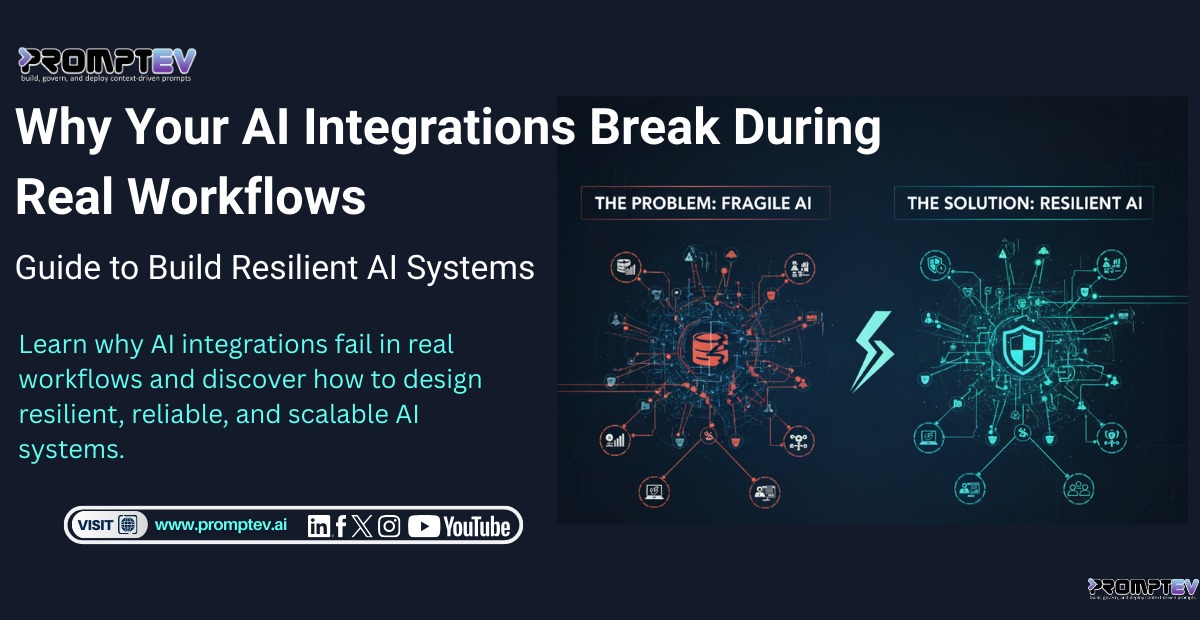
You build an AI system. It works perfectly in testing. Demo looks flawless. Everyone’s impressed. But the moment real users start working with it, things break. Responses fail, and APIs crash. Outputs behave unpredictably, and workflows stop.
Sound familiar? This happens to many organizations. AI works in theory, but not in reality.
Let’s talk about why and how you ensure your AI systems stay resilient, dependable, and production-ready.
Why AI Integrations Break in Real Workflows
1. AI Isn’t Designed Around Real-World Complexity
Real workflows are messy. People switch tools, data formats change, inputs are inconsistent, and edge cases appear every day. Most AI systems are initially designed for ideal condition:s perfect inputs, consistent formatting, and predictable user behavior.
When these systems encounter real-world variability, they often fail. Designing AI with real-world complexity in mind ensures it can handle unexpected situations, maintain functionality, and reduce downtime.
2. APIs Aren’t Stable Forever
AI relies heavily on APIs, which can throttle requests, timeout under load, change versions without notice, or even temporarily fail. Without fallback logic and resilient architecture, even a single API failure can collapse your entire workflow.
Building systems that anticipate API instability through retries, caching, and backup processe ensures your AI keeps running even when external services falter.
3. No Error Handling = Guaranteed Failure
Many AI systems assume everything will work perfectly. Real-world workflows, however, are full of errors: missing inputs, invalid data, failed calls, and unexpected outputs.
Without proper error handling, these small issues accumulate until the system crashes or produces unreliable results. Implementing comprehensive error management allows your AI to detect problems, recover gracefully, and continue functioning smoothly.
4. Data Quality Isn’t Controlled
Bad or inconsistent data is one of the biggest causes of AI failure. Outdated, unverified, or improperly formatted data leads to poor outputs and unreliable workflows.
Maintaining a strong data pipeline—through validation, regular updates, and consistency checks ensures your AI has accurate information to work with, keeping results dependable and reducing errors in operations.
5. There Is No Observability
Many teams deploy AI without tracking performance metrics, logging errors, monitoring health, or analyzing workflow trends.
Without observability, issues happen silently, making it nearly impossible to debug or improve. Implementing dashboards, logs, and analytic tools gives you real-time insight into your system, helping you prevent failures before they impact users.
How to Build AI Systems That Don’t Break
1. Design for Real Conditions
Assume messy data, unpredictable user behavior, network fluctuations, and system errors.
By designing for imperfection, your AI can adapt to real-world conditions instead of failing.
Systems built with this mindset handle stress better, are more reliable, and maintain performance under varying conditions.
2. Implement Fail-Safes and Recovery
Never rely on a single process. Include backup models, retry logic, fallback answers, offline capabilities, and graceful degradation.
These measures allow your AI system to bend instead of break, handling errors gracefully without interrupting workflows, even when parts of the system fail.
3. Control the Data Pipeline
Reliable AI starts with reliable data. Ensure proper validation, version control, freshness checks, and consistency management.
A well-managed pipeline guarantees that the AI operates on accurate, up-to-date data, which minimizes errors and improves the overall resilience of workflows.
4. Build Monitoring & Observability
Track performance drops, failed requests, latency spikes, and accuracy changes.
Monitoring gives you actionable insight and alerts you before small problems become
workflow-stopping failures. Observability is the difference between guessing and proactive system management.
5. Test Beyond the Demo
Real testing goes beyond controlled environments. Include stress testing, edge case simulations, real-user scenarios, and full workflow trials.
AI that works in a demo might fail in production. Comprehensive testing ensures your system is ready for real-world complexity and delivers consistent results in day-to-day operations.
Final Word
AI doesn’t fail because it’s weak, it fails because it’s deployed without resilience thinking. With Promptev, AI systems are designed with structure, fallback, observability, and real-world awareness at the core. Instead of collapsing under real-world complexity, your AI becomes a reliable, trusted part of your workflow.
FAQs
Q1: Why do AI systems fail after launch?
Because they’re not designed for real-world conditions, only ideal scenarios.
Q2: Can AI systems truly be reliable?
Yes, with resilience engineering, monitoring, and strong architecture.
Q3: What’s the biggest cause of integration failure?
Weak handling of errors, APIs, and real workflow complexity are the biggest cause of integration failure.
Q4: Is data quality really that important?
Absolutely. Bad data eventually breaks workflows.
Q5: What ensures long-term AI stability?
Observability, fallback logic, structured data pipelines, and continuous improvement ensure long-term AI stability.

Faisal Saeed is Founder & CEO of Promptev, building next-gen context engineering infrastructure that enables teams to orchestrate, scale, and deploy production-ready generative AI systems with confidence.