AI Costs Are Out of Control: How Context-Aware Workflows Cut Costs by Up to 40%
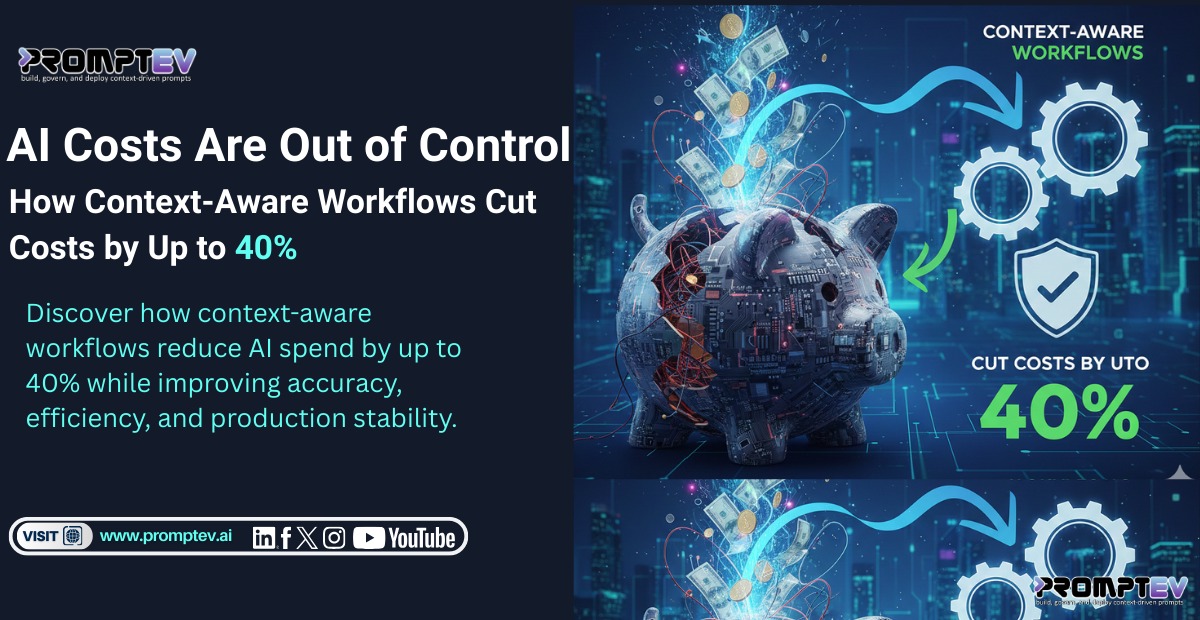
If you’re running AI at scale, you’ve experienced the same frustrating pattern every month. Your cloud bills spike. Token consumption grows exponentially. The costs of model invocations climb steadily. And despite spending more, the quality and consistency of outputs do not improve as expected.
You anticipated that scaling your AI systems would improve efficiency. Instead, it feels like your budget is constantly leaking.
The uncomfortable truth is that most AI teams overspend not because the models themselves are expensive, but because their workflows are inefficient. When context is unmanaged, each request consumes far more resources than necessary. This inefficiency multiplies across thousands of queries, quickly inflating costs.
This article explores why AI costs escalate so quickly and how context-aware workflows can reduce your spend by up to 40% while enhancing accuracy and performance.
Why AI Costs Escalate Faster Than Expected
Initially, everything appears manageable. You run a few test prompts, the cost is minimal, and the results seem promising. However, as usage grows, the expenses accelerate in ways that are not immediately obvious.
Your AI spend begins to expand across multiple hidden layers. Token consumption increases with longer prompts. Retrieval calls multiply as more users interact with the system. Context windows grow unnecessarily large. And model invocations occur more frequently than needed. Each of these factors compounds, leading to a dramatic increase in overall costs.
Traditional optimization strategies often fail because they react to visible issues instead of addressing the root cause: inefficient context management.
The Hidden Cost: Context Waste
Every AI request carries context information passed to the model. It includes instructions, retrieved documents, conversation history, rules, and system messages. When this context is unmanaged, it drives up costs.
Excessive tokens are sent for every query. The model spends more time processing irrelevant or redundant data. Poorly structured context results in incorrect or incomplete answers, prompting retries, clarifications, or manual intervention. This chain reaction is costly and undermines efficiency.
AI cost reduction begins here: by managing and optimizing context, you can prevent waste and reduce costs without compromising the quality of your AI outputs.
What Context-Aware Workflows Mean
Context-aware workflows go beyond simply sending more data to the model. They focus on delivering the right information at the right time for each specific task.
A context-aware system understands the purpose of each request before generating a response. It evaluates user intent, applies task-specific boundaries, prioritizes relevant information, reuses stable context, and determines when a large language model is truly necessary.
This approach reduces waste and improves first-pass accuracy. Rather than treating every request uniformly, context-aware workflows optimize resources, ensuring every AI invocation is purposeful and efficient.
How Context-Aware Workflows Reduce AI Costs by Up to 40%
Cost savings from context-aware workflows arise from multiple complementary strategies.
1. Intent-Based Routing Eliminates Unnecessary Model Calls
Not all requests require the highest-capacity models. By classifying user intent upfront, you can:
- Route straightforward queries to cached responses or lightweight models
- Allocate high-capacity models only to high-value or complex tasks
- Reduce redundant or unnecessary calls to expensive models
This strategy alone can significantly lower the number of large model invocations.
2. Context Pruning Cuts Token Usage
Most AI prompts include excess information that the model does not need. Context pruning actively removes:
- Redundant instructions or repeated text
- Outdated conversation history
- Low-priority retrieved documents or data chunks
Fewer tokens per request translates directly into cost savings and faster model response times.
3. Structured Context Improves First-Response Accuracy
Inefficient context leads to bad answers, which in turn increase costs due to retries or human intervention. Structuring and prioritizing context ensures that models have clear, relevant information to produce accurate results on the first attempt.
4. Reusable Context Prevents Duplicate Processing
Many AI workflows redundantly send the same information across multiple requests. Context-aware systems cache stable and reusable context layers, avoiding repeated embeddings, retrieval operations, and token usage.
5. Smaller Models Become Viable
Improved context quality reduces the reliance on high-capacity models. Tasks that previously required expensive LLMs can now be handled by smaller, more cost-effective models, further compounding savings.
Why Traditional Cost-Cutting Strategies Fail
Typical cost-cutting approaches involve reducing maximum tokens, shortening prompts, or limiting model usage. While these measures reduce costs temporarily, they also compromise the value of AI outputs and create brittle workflows.
Context-aware workflows, on the other hand, reduce costs without sacrificing accuracy, reliability, or user satisfaction. By optimizing the system as a whole, they deliver sustainable savings.
Context-Aware Workflows vs Prompt Optimization
Prompt optimization can feel productive because changes are immediately visible. Small wording edits often produce noticeable output variations. However, prompts are inherently fragile; minor changes can produce unpredictable results and require constant retesting.
Context-aware workflows work at a systemic level, shaping the information delivered to the model before a prompt is even constructed. This makes workflows scalable, testable, and reliable, particularly in production environments.
What This Looks Like in Real Production Systems
In advanced AI deployments, context and cost management are engineered, not improvised. Key practices include:
- Intent classifiers directing requests to appropriate sources
- Context routers dynamically select data based on task relevance
- Versioned context layers to test updates safely
- Continuous monitoring of token usage and model performance
These systems do not rely on guesswork. Every action is designed to maximize efficiency and minimize waste, delivering measurable AI efficiency optimization.
How to Start Reducing AI Costs Today
You can begin by auditing your context management strategies.
Ask yourself:
- Why is each token in the prompt necessary?
- Can this context be reused across multiple requests?
- Does this task require a high-capacity model, or can a smaller one suffice?
- Can intent detection prevent unnecessary model calls?
Each unnecessary token represents wasted money, and at scale, these small inefficiencies accumulate into substantial costs.
Wrapping Up
AI costs escalate because most systems lack deliberate control over context and workflow. Promptev addresses this challenge through context-aware workflows, ensuring that every token, prompt, and model invocation serves a clear business purpose.
By adopting context-first practices with Promptev, organizations can reduce AI spending, improve response accuracy, and make scaling predictable. Through structured context and workflow governance, Promptev helps transform AI from a cost liability into a strategic asset—driving measurable efficiency, reliability, and sustainable growth.
FAQs
1. How can context-aware workflows reduce AI costs?
Context-aware workflows reduce costs by optimizing which information is sent to the model, prioritizing relevant context, reusing stable data, and routing tasks to the appropriate model, which minimizes unnecessary token usage and model invocations.
2. Do context-aware workflows affect AI accuracy?
Yes. By structuring context and focusing on relevant data, these workflows improve the model’s first-pass accuracy.
3. Can smaller models replace expensive LLMs with context-aware workflows?
Often, yes. Improved context quality allows certain tasks to be handled by smaller, more cost-efficient models.
4. What are the most common causes of rising AI costs?
Unmanaged context, excessive token usage, redundant model calls, unstructured prompts, and inefficient task routing are usually the drivers of rising costs.
5. How do I start implementing context-aware workflows?
Start by reviewing your AI workflows. Check token usage, use intent-based routing, remove extra context, cache repeat data, and monitor performance to keep improving efficiency.

Faisal Saeed is Founder & CEO of Promptev, building next-gen context engineering infrastructure that enables teams to orchestrate, scale, and deploy production-ready generative AI systems with confidence.