Top 7 Agentic AI Use Cases in Data Engineering
You don’t lose sleep because of data. You lose sleep because pipelines break at 3 AM.
Modern data engineering isn’t just about moving data anymore. You’re managing dozens of sources, real-time streams, schema changes, compliance rules, and cloud costs, all at once. One silent failure can corrupt dashboards, delay decisions, and trigger a chain reaction across teams.
Now imagine if your pipelines didn’t just fail less… Imagine they noticed problems, fixed them, and kept running without waiting for you.
That’s the shift agentic AI brings.
Agentic AI isn’t another dashboard. It’s a layer of intelligence that observes your data systems, learns their behavior, and takes action automatically. Instead of reacting to alerts, your infrastructure starts reacting for you. And in 2026, this isn’t experimental anymore. It’s operational.
Let’s break down what that means in real engineering terms!
What Agentic AI Actually Means for Data Engineers
Traditional automation follows scripts. But agentic AI follows intent.
- A rule-based system says: if job fails → restart once.
- Agentic AI asks: why did it fail, what changed, and what’s the best fix?
It watches patterns across pipelines. It understands schema drift. It tracks workload behavior. It adjusts resources, and over time, it becomes better at predicting failures before they happen.
Why Agentic AI Matters Now
Data engineering pressure isn’t slowing down; it’s accelerating. Modern pipelines operate in an environment where complexity grows faster than human teams can manage manually. At a certain scale, oversight becomes a bottleneck. Engineers get pulled into constant firefighting instead of building resilient systems.
Teams adopting agentic AI are reporting:
- fewer emergency incidents
- faster recovery from failures
- lower cloud costs
- higher data reliability
- less engineer burnout
When engineers aren’t rescuing pipelines every week, they focus on architecture, optimization, and long-term design. Work moves from reactive maintenance to strategic engineering. Instead of babysitting fragile workflows, you build systems that evolve on their own. That’s why agentic AI isn’t a future upgrade; it’s becoming a present necessity.
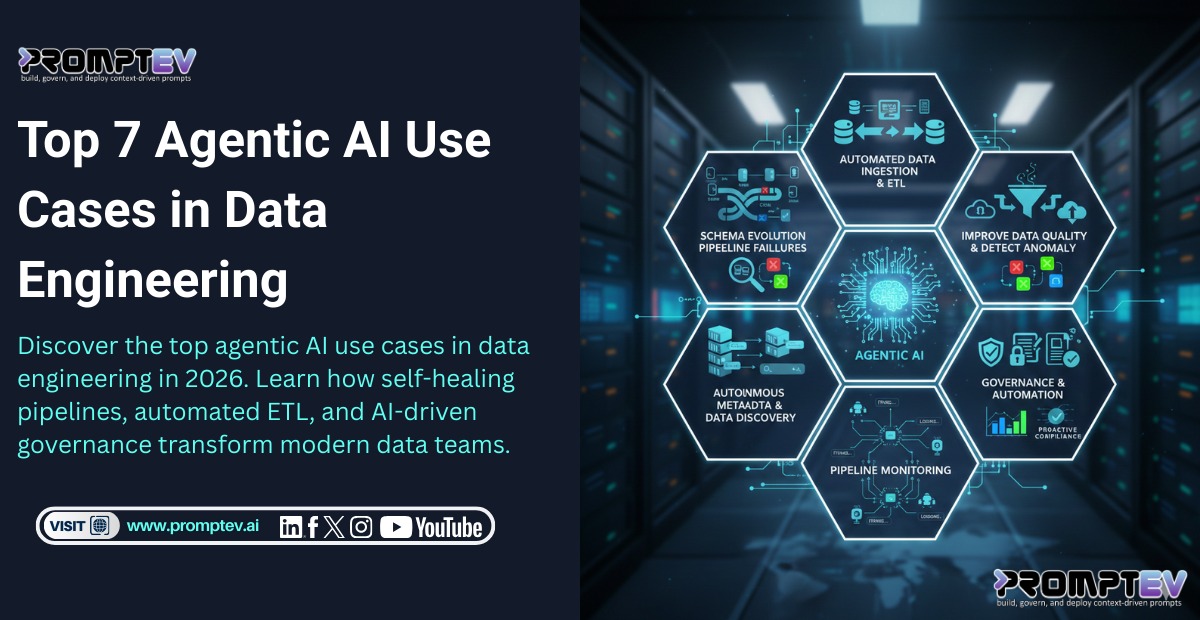
Top 7 Agentic AI Use Cases in Data Engineering
Schema Evolution Without Pipeline Failures
Schema drift used to be a silent killer. A renamed column or extra field could stop an entire workflow. Agentic AI monitors structural changes and adjusts transformations in real time. Pipelines stay alive even when upstream systems evolve. You stop reacting to change and start absorbing it.
Automated Data Ingestion & ETL
You no longer rewrite pipelines every time a new source appears. Agentic AI detects new schemas, maps fields, validates formats, and integrates sources automatically. Retail chains, SaaS platforms, and global enterprises use this to onboard data in hours instead of weeks. This turns ingestion into a continuous, intelligent process rather than a manual project.
Improve Data Quality & Detect Anomaly
Bad data spreads quietly. Agentic systems catch missing values, duplicates, outliers, and corrupted records the moment they appear. They repair or quarantine issues before dashboards consume them. High-quality data becomes the default state, not a cleanup phase.
Pipeline Monitoring
Traditional systems alert you after failure. Agentic AI fixes the failure first, then logs what happened. It can restart jobs, reroute workloads, rebalance clusters, and recover dependencies without human input. Large financial infrastructures already use this to prevent cascading outages.
Autonomous Metadata & Data Discovery
Most organizations don’t lack data. They lack discoverable data. Agentic AI automatically tags datasets, tracks lineage, enriches metadata, and organizes catalogs continuously. Engineers no longer maintain documentation manually. Search becomes reliable. Trust improves. Adoption rises.
Cloud Cost Optimization
Computing waste is invisible until the bill arrives. Agentic AI monitors workload patterns and scales infrastructure dynamically. Idle resources pause. Bursts allocate automatically. Storage is compacted intelligently. Streaming-heavy industries like logistics and IoT see massive savings without sacrificing performance.
Governance & Compliance Automation
Regulation is no longer periodic; it’s continuous. Agentic AI audits access patterns, flags policy violations, and enforces data protection rules in real time. Privacy compliance becomes proactive instead of reactive. Healthcare and finance depend on this to avoid catastrophic fines.
5 Industries Where Agentic AI Is Already Making an Impact
Agentic AI is already running quietly in many organizations — often without teams realizing how much autonomy their pipelines now have. While behavior varies slightly across industries, the underlying pattern is consistent: systems that learn, adapt, and act without waiting for human intervention.
Let’s take a look at the real-world impact across industries.
Legal & Law Firms: AI-Assisted Compliance and Case Data
Law firms manage massive amounts of sensitive information, contracts, case files, regulations, and client data. Manual monitoring is slow and error-prone.
Legal Agentic AI automatically organizes case data, tracks regulatory changes, and flags compliance risks in real time. For example, if a new privacy law or court ruling affects ongoing cases, the system alerts the team and suggests updates to documents or workflows. This reduces legal risk, ensures up-to-date compliance, and frees attorneys from repetitive administrative work.
Finance: Fraud Detection That Learns in Real Time
Traditional banking systems relied on fixed rules, thresholds, and static alerts. Today, AI agents continuously monitor transaction behavior. Even subtle deviations, such as an unusual device fingerprint, an unexpected location sequence, or an irregular pattern, trigger instant model adjustments. Suspicious flows are automatically isolated. This is not post-incident detection; this is live learning in action.
Healthcare: Clean, Compliant Patient Data at Scale
Hospitals manage extremely complex, messy data ecosystems. Lab systems, wearable devices, EHR platforms, and imaging records all produce different formats.
Agentic AI doesn’t just ingest data; it understands context. Sensitive fields are automatically labeled, compliance rules applied, duplicate records merged, and missing attributes flagged.
The result: doctors receive cleaner dashboards, compliance teams see fewer violations, and engineers no longer spend hours manually cleaning data.
IoT & Manufacturing: Machines That Signal Before They Break
Factories and IoT networks generate thousands of sensor signals every second. Human monitoring is impossible at this scale.
Agentic AI learns the behavioral baseline for every machine: vibration patterns, temperature signatures, and load fluctuations. When deviations occur, it isolates anomalies and triggers maintenance workflows automatically.
Downtime becomes predictive, not reactive. This shift can save millions, as unplanned shutdowns are the most costly failures in manufacturing.
SaaS & Tech Infrastructure: Self-Cleaning Data Lakes
Data engineers’ biggest nightmare: silent data decay. Duplicate files, schema mismatches, dead partitions, and forgotten staging zones accumulate over time.
Agentic AI continuously scans storage ecosystems, quietly removes redundant artifacts, compacts data, and corrects structural inconsistencies. Weekend cleanup culture disappears. Engineers log in on Monday to find systems already optimized.
Conclusion
Agentic AI marks the transition from reactive data engineering to autonomous systems.
Pipelines become resilient. Costs become predictable. Governance becomes continuous. Engineers regain time to innovate. The shift isn’t optional for long. As complexity grows, intelligent automation becomes the only scalable path forward. Teams that adopt early don’t just run smoother systems; they build smarter ones.
FAQs
1. What are the main agentic AI use cases in data engineering?
Automated ETL, schema management, anomaly detection, self-healing pipelines, governance automation, and real-time streaming optimization are the primary applications.
2. Is agentic AI safe for regulated industries?
Yes, when deployed with oversight. Many healthcare and finance organizations already use agentic monitoring with strict compliance guardrails.
3. Does agentic AI remove the need for data engineers?
No. It removes repetitive work and elevates engineers toward architecture and strategy.
4. How difficult is adoption?
Moderate. Successful teams start small, validate trust, and scale gradually.
5. What skills should engineers learn now?
AI system design, pipeline observability, governance architecture, and human-AI collaboration workflows.

Faisal Saeed is Founder & CEO of Promptev, building next-gen context engineering infrastructure that enables teams to orchestrate, scale, and deploy production-ready generative AI systems with confidence.